Table of Contents
Zone 2 running is easy running done at 60 to 70 percent of your maximum heart rate, slow enough to hold a conversation and sustainable for an hour or more. Most of your weekly mileage belongs there, whatever distance you race.
Below we cover what the zone is, how to find your own numbers by heart rate and by pace, how to build the runs into a week, and the mistakes that keep runners from getting anything out of them.
What zone 2 running is
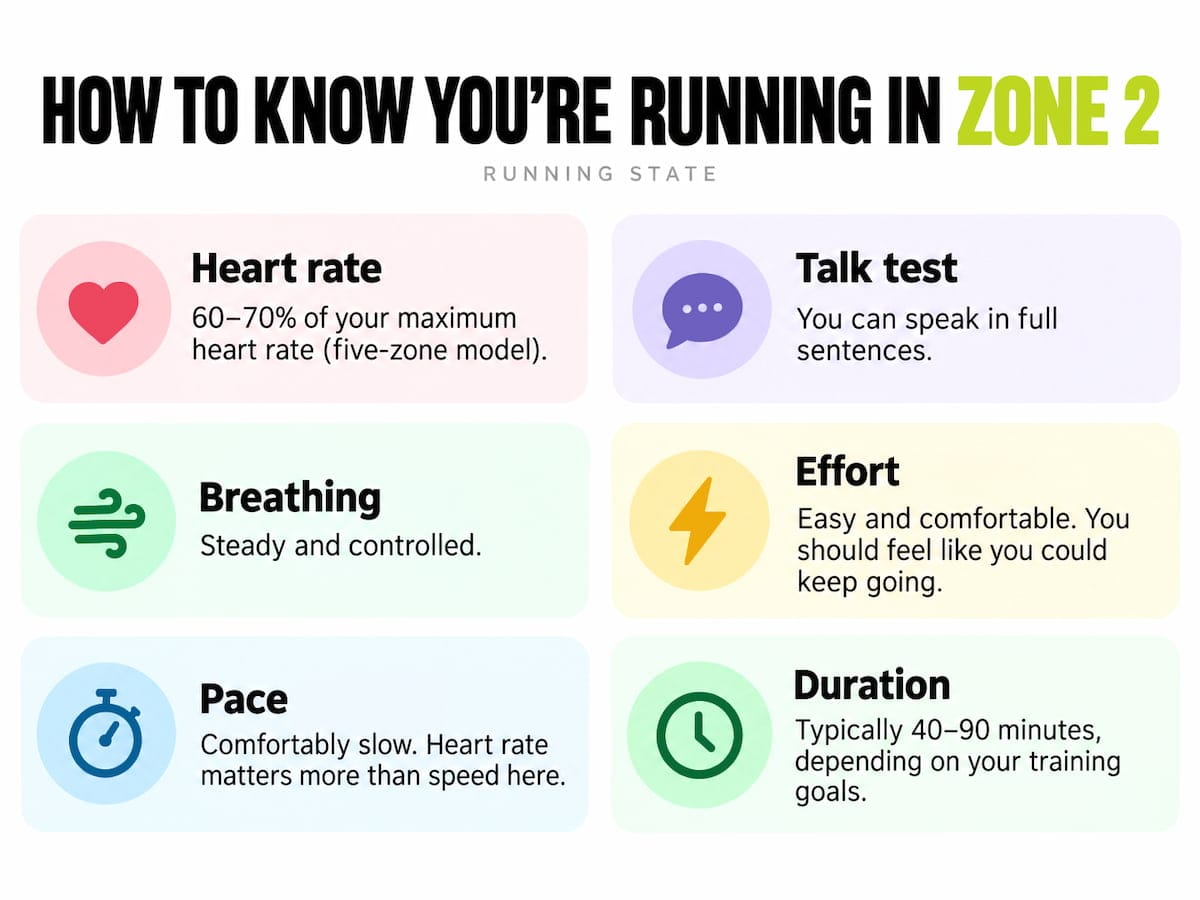
Zone 2 is the second of the five heart rate training zones, and in the model used by most watches it covers 60 to 70 percent of your maximum heart rate. Your legs get nearly all of their energy through aerobic metabolism at that effort.
The 60 to 70 percent band is a convention built into watch software, set low on purpose. The physiological version is everything below your aerobic threshold, the point where blood lactate first climbs above resting levels, usually put at around 2 millimoles per liter.
In trained runners that threshold falls somewhere around 75 to 85 percent of maximum heart rate, which puts their real aerobic ceiling above the top of the watch band. In new runners it can be lower. Running at 65 percent of your maximum is aerobic for everyone, and whether 75 percent is aerobic for you depends on where your own threshold falls.
By feel, zone 2 is conversational, meaning you can speak in full sentences, and your breathing is deeper than at rest while staying even. Many runners find the effort frustratingly slow at first, which most of them get used to within a few weeks.
The five heart rate zones
| Zone | % of max heart rate | How it feels | What it is for |
| 1 | 50 to 60% | Very easy | Recovery runs, warm-ups, cool-downs |
| 2 | 60 to 70% | Easy, full sentences | Easy runs and long runs |
| 3 | 70 to 80% | Moderate | Steady and marathon-pace running |
| 4 | 80 to 90% | Hard, a few words | Threshold and tempo runs |
| 5 | 90 to 100% | Maximal | Short intervals, hill sprints, the finish |
Our full guide to heart rate zones for runners covers the other four in detail.
Is zone 2 running the same as easy running?
For most runners, yes. An easy run and a zone 2 run describe the same effort, one by feel and one by a number on your wrist.
An easy run judged by feel drifts upward on hills, in heat and over the closing miles of a long run, while a zone 2 run holds the number and lets the pace fall.
Beyond that, coaches draw the easy band wider than watch software does. For example, Jack Daniels, the American coach whose training system is used in running plans across the world, put easy pace at 65 to 79 percent of maximum heart rate, which crosses the five-zone model’s line between zone 2 and zone 3.
Why zone 2 means different things in different systems
Four separate systems use the word “zone 2”, and the numbers they give are not interchangeable. Below is what the term means in each one, and which your watch is using.
- Five-zone percentage of maximum. Zone 2 runs from 60 to 70 percent of maximum heart rate. This is the default on Garmin and Polar, and it is the system we use in this article.
- Heart rate reserve. The Karvonen method works from the gap between your resting and your maximum heart rate, and it is what Apple Watch uses to set zones automatically. The same 60 to 70 percent figures put the top of your zone 2 roughly 10 to 20 beats higher, depending on your resting heart rate.
- Three-zone polarized model. Endurance research often splits training into three zones at the two lactate thresholds. In that system zone 1 is everything below the aerobic threshold, which is where easy running happens, and zone 2 means moderate work above it. Someone using three-zone language is describing harder running than you are.
- The MAF method. Phil Maffetone’s 180 formula sets an aerobic ceiling of 180 minus your age, adjusted down by 5 or 10 beats for illness, injury, inconsistent training or a recent return to running, and up by 5 after more than two years of healthy progress. It gives you a single ceiling to stay under, with no lower bound.
So before you compare your numbers with another runner’s, check which system they are using.
5 benefits of zone 2 running
Easy running is the largest part of a training week, so it is worth knowing what you are buying with those hours.
Here are five benefits that matter most:
- It builds your aerobic base. Easy mileage raises stroke volume, grows the capillary network feeding your muscles and increases the number of mitochondria inside them. Those adaptations are what let you hold a faster pace at the same effort months later.
- It lets you add volume you can recover from. A zone 2 run leaves you ready to train again the next day, and that is the real mechanism behind the zone. Mitochondrial content rises with the number of sessions you complete, so easy running is how you raise that number without spending 48 hours recovering from each one.
- It trains your body to use fat. Fat oxidation peaks at low intensity, typically between 45 and 65 percent of maximum heart rate, which covers zone 1 and the lower part of zone 2. The exact intensity varies widely between runners.
- It keeps your hard sessions hard. Runners who hold their easy days easy arrive at interval and threshold workouts able to hit the paces. In trials comparing training distributions, groups doing most of their work at low intensity improved more than groups spending half their time at threshold, though these studies are small.
- It keeps your training consistent. Most running injuries follow a jump in volume or intensity. Easy running is the least stressful way to raise weekly mileage, and it is the session you can still complete after a bad night of sleep.
How to calculate your zone 2 heart rate
The methods below run from quickest to most accurate.
Percentage of your maximum heart rate
Estimate your maximum, then take 60 to 70 percent of it. The old 220 minus age formula carries a standard error of around 10 beats per minute, which can put your whole zone in the wrong place. A closer estimate comes from 208 minus 0.7 times your age.
Zone 2 by the five-zone watch model
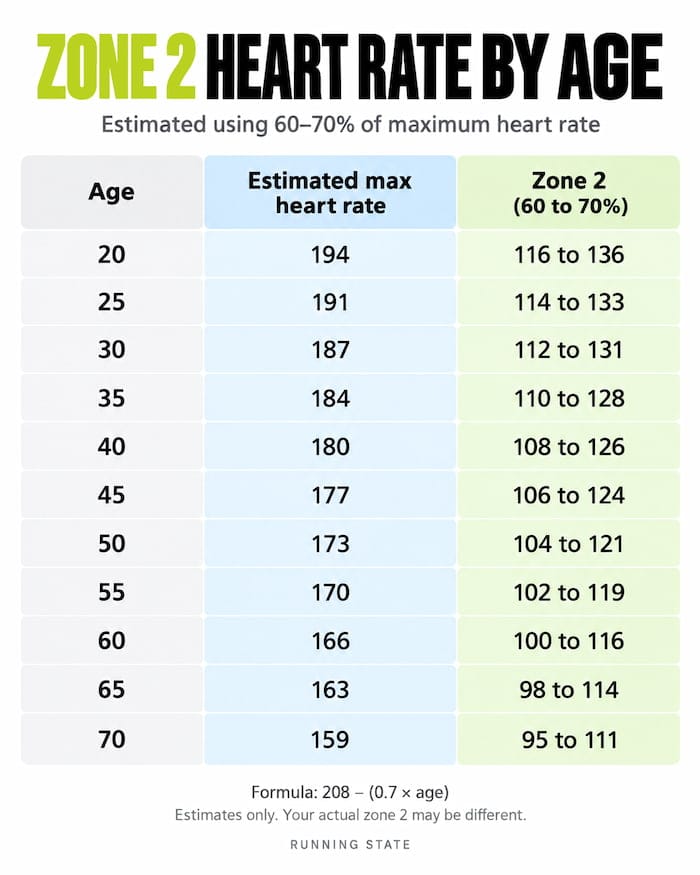
The table is conservative by design. A lactate test or a field test that puts your aerobic threshold higher means your easy running can go up to that figure, and a measured maximum heart rate from a hard race replaces the formula entirely.
Percentage of heart rate reserve
The Karvonen method brings your resting heart rate into the calculation: resting heart rate plus 60 to 70 percent of the difference between your maximum and your resting rate.
Measure your resting rate in bed on three consecutive mornings and take the average. This method suits fit runners with low resting rates, whose true easy ceiling usually falls above what a flat percentage of maximum suggests.
The talk test
Speak a full sentence out loud: comfortable speech in complete sentences means you are in the right range, and the last point where speaking stays comfortable corresponds closely to the first ventilatory threshold in laboratory work. The talk test needs no formula, and it works on your very first run.
The talk test also shows when a formula has put your zone too low. Speaking in full sentences 5 to 8 beats above the top of your calculated zone 2 means your aerobic ceiling is higher than the table suggests, and the effort you can hold while talking is the one to train.
A lactate or ramp test
A lab test gives you your actual thresholds from blood samples taken at rising speeds, which is the only way to measure your aerobic threshold directly. A supervised ramp test on a treadmill gets you part of the way for less money. This is worth doing once if you plan to train by heart rate for years.
How to find your zone 2 running pace
Your zone 2 pace is the result of holding the right heart rate, so it is worth knowing but never worth chasing.
For most recreational runners the pace works out 1:30 to 2:30 per mile slower than 10K race pace, which is about 55 to 95 seconds per kilometer.
To find yours, run 45 minutes on flat ground on a cool day. Ignore the first 10 minutes while your heart rate rises to meet the effort, hold the top of zone 2 from minute 10 to minute 40, and look at your average pace across that section—that number is your current zone 2 pace, and it moves as your fitness changes.
Heat, short sleep, a hard session the day before, caffeine and a head cold all raise your heart rate at an unchanged pace. Run by the heart rate on those days and accept the slower pace, because the same number means the same load on your body.
How to train in zone 2
How long should your zone 2 runs be?
Between 40 and 90 minutes for most runners. Thirty minutes makes a useful recovery run, though runs of an hour or longer do the most for your aerobic base.
One longer run of 90 minutes to two hours a week suits anyone training for a half marathon or beyond.
How often should you run in zone 2?
Three to five times a week, making up most of your weekly volume. Elite distance programs keep roughly 80 percent of weekly running at easy intensity, and that is the share to aim for yourself.
Keep one or two hard sessions a week and run everything else easy. Place the hard days about 72 hours apart where your schedule allows, with easy runs in between. A zone 2 run the day after intervals helps your legs recover from the session.
What to do when your heart rate drifts up
A rise of several beats per minute over a long run at a fixed pace is normal physiology.
In laboratory work at a constant moderate intensity, heart rate climbed about 10 percent across two hours without fluid replacement, and about 5 percent with it, as plasma volume fell and body temperature rose.
There are two ways to handle a heart rate that drifts up:
- Drink on any run longer than an hour.
- Let the pace fall in the second half, and stop trying to hold both numbers at once.
After that compare your halves. If your pace drops more than about 5 percent at the same heart rate, the run was too long or too warm for your current fitness.
5 common zone 2 running mistakes
- Starting the run too fast. Heart rate answers a change in effort 30 to 60 seconds late, so the opening minutes feel correct while you are already above the band. Run the first 10 minutes slower than your zone 2 pace and let the number come up to meet it.
- Leaving your watch’s default zones unchecked. Most watches build zones from 220 minus age until you change the setting. Open the heart rate settings and enter your own figure.
- Trusting a wrist sensor in the cold. Optical sensors read poorly on cold skin and sometimes lock onto your cadence, showing a steady 150 to 170 beats per minute that has nothing to do with your heart. A chest strap solves it.
- Fighting hills to hold the number. Shorten your stride and let your pace slow on the climb. On a rolling route you will cross into zone 3 on every climb, so pick flatter ground for these runs.
- Running only in zone 2. Easy volume raises your aerobic base and leaves your top-end speed untouched. Without a weekly threshold session or interval workout your race times stall. Add a speed session once a week if you are chasing faster times.
Conclusion
Zone 2 is the slowest running in your week and the largest share of it. No single easy run changes your fitness, which is why zone 2 is measured in weeks of accumulated time at the effort.
Three to five runs a week at 60 to 70 percent of maximum, for 40 to 90 minutes each, give you the volume that raises stroke volume, capillary density and mitochondrial content over a training block—the aerobic base your race pace rests on, whether that race is a 10K or a marathon.
FAQ
Should you walk to stay in zone 2?
Yes, when that is what the number requires. New runners and runners returning after a long break often cross into zone 3 at any running pace, and walk breaks are the reliable way to stay in the zone while aerobic fitness catches up. Walk breaks get shorter as your fitness improves.
Is zone 2 running good for weight loss?
It helps because easy runs are the ones you can do often. Weight change follows your overall energy balance across the week, and three or four zone 2 runs add up to more activity than one or two hard sessions that need days of recovery. Fat oxidation does peak at this low intensity, so you burn a higher share of fat during the run itself, though that on its own does not shift the weekly balance.
Does zone 2 running make you faster?
Over months, yes, by raising the pace you can hold at any given heart rate. Zone 2 work on its own leaves your top-end speed alone, so you should add a weekly threshold session or interval workout to convert that aerobic base into faster times.
Can you run in zone 2 every day?
You can, though we would recommend taking days off. Daily running suits runners with years of steady mileage behind them, and even they keep some of those days down to 30 minutes. If you want more aerobic time in your week, add minutes to the runs you already have before adding days.
How long does it take to see results from zone 2 training?
Measurable changes inside the muscle begin within about two weeks. The result you can see on your watch, a quicker pace at the same heart rate, usually takes two to three months of consistent running, so plan a 12-week block before judging it.