Table of Contents
Running cadence is the number of steps you take in a minute, counting both feet. Your watch reports it as spm, and it is one of the few things about your running form that you can measure without a lab, a coach or a camera.
In this guide, we cover what the numbers mean, where the 180 rule came from, how to measure your own cadence, and how to raise it if you need to.
What a good running cadence is
Most recreational runners have a cadence of around 150 to 180 steps per minute, depending on their pace, height, and running mechanics. There is no single ideal number. A cadence of 164 can be efficient for a tall runner, while 184 can be perfectly normal for a shorter one.
Cadence naturally increases as you run faster. But deliberately taking more steps per minute won’t make you faster or more efficient. What a small increase can do is reduce the load on your knees and hips with each step, which may help runners dealing with shin or knee injuries.
So a good running cadence is one that feels natural, suits your running pace, and doesn’t place unnecessary stress on your legs.
Where the 180 steps per minute rule came from
The figure comes from Jack Daniels, the American exercise physiologist and distance coach. At the 1984 Olympic Games, he and his wife counted the steps of about 50 runners competing in events from the 800 meters to the marathon. Only one runner had a cadence below 180 steps per minute.
But 180 wasn’t the average. It was closer to the lower end of what Daniels observed. Some middle-distance runners exceeded 200 steps per minute, and all the athletes were competing at an elite level.
Daniels later recommended aiming for around 180 steps per minute, believing that a quicker turnover could reduce landing impact. His Olympic observations describe elite racing, though, so a recreational runner doing an easy 10:00-minute mile (6:13 min/km) has no reason to aim for the same number as an Olympic finalist.
How to measure your cadence
The quickest method needs nothing but a watch face.
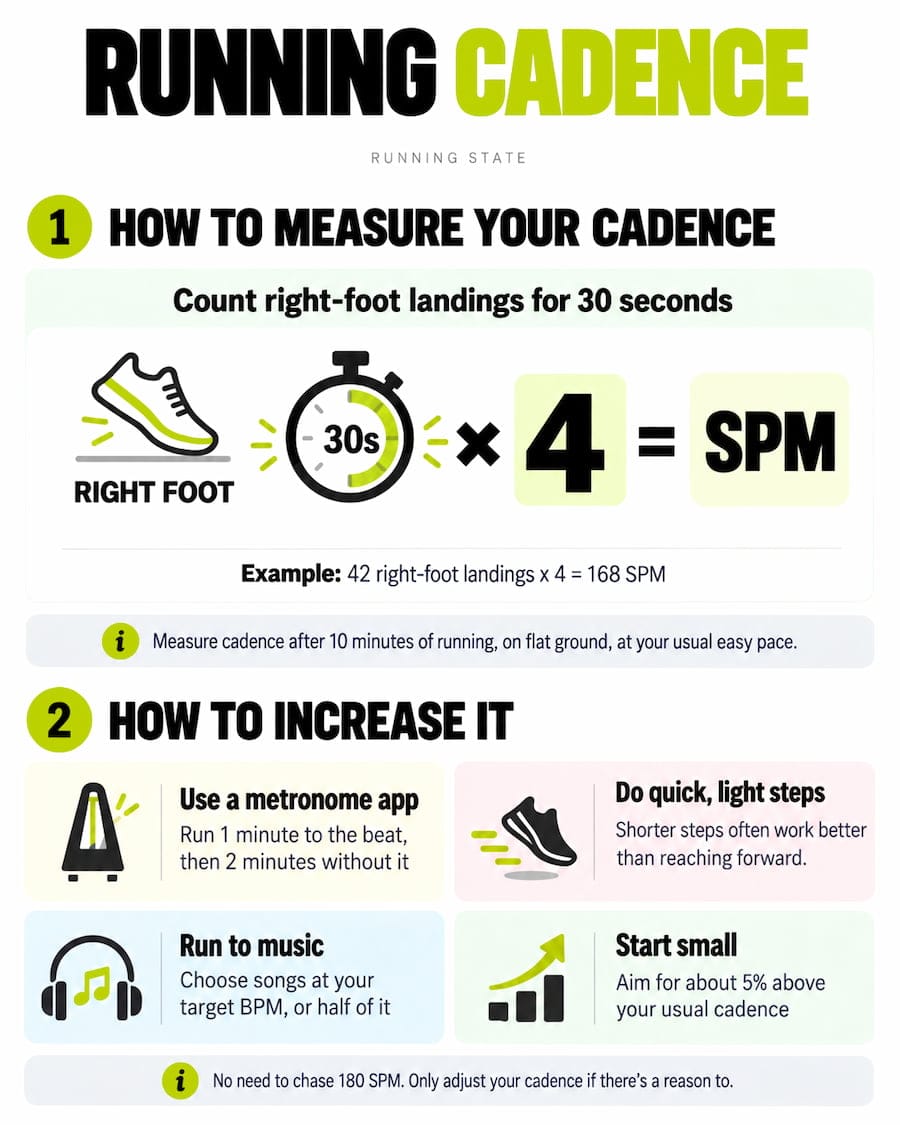
Count every time your right foot touches down for 30 seconds, then multiply by four. Counting both feet for 30 seconds and doubling the result works the same way.
Running watches give you the number automatically, from the accelerometer in the wrist unit or from a foot pod. Wrist-based cadence measurements are generally reliable, although unusual arm movements can affect accuracy.
Manual counts and device readings can differ, so use the same method every time you track a change in your cadence.
Take your baseline on a flat route at your usual easy pace, after at least 10 minutes of running. Repeat it on a faster run, because one number covers only one pace.
Why your cadence might be low
If your cadence seems low, don’t rush to change it. Your step rate depends on several things, and a lower number doesn’t necessarily mean you’re running incorrectly.
Here are five reasons your cadence might be lower than expected:
- Your height and leg length. Taller runners with longer legs often take fewer steps per minute than shorter runners at the same pace. It’s a natural difference in running mechanics, not something you need to correct.
- Your running pace. Cadence generally decreases when you slow down. That’s why your step count on an easy run will often be lower than during a tempo workout or race.
- The terrain. Hills and uneven ground change your stride. Cadence may rise or fall depending on the slope, footing, and how much your speed changes.
- Fatigue. Tired legs can change your running mechanics. Some runners take fewer steps as they fatigue, while others maintain their cadence and shorten their stride.
- Overstriding. Landing too far ahead of your body can be associated with unnecessarily long steps and a lower cadence at a given speed. Unlike the factors above, this is something worth examining, particularly if you experience recurring discomfort.
How to increase your running cadence
Before changing anything, check whether you need to. Raising your cadence may be worth trying if any of these apply:
- Your cadence is unusually low for your running speed, especially if you tend to overstride.
- You have recurring knee pain or a history of certain shin or tibial stress injuries, and a gait assessment suggests that changing your cadence could help.
- Your legs feel unusually beaten up after easy runs on flat ground, and your running form may be contributing to the problem.
If you run comfortably, have no recurring injuries and don’t overstride, there’s usually no reason to chase a higher number. Your training volume and consistency deserve more attention.
If you decide to make a change, start by increasing your cadence about 5 percent above your usual number. Increases of 5 to 10 percent are the usual working range, and the right adjustment depends on your running mechanics and how your body responds.
For example, from 168 steps per minute, a 5 percent increase takes you to about 176. From 160, it takes you to 168. Don’t jump straight to 180 just because it’s a familiar number. Changing your stride too abruptly can feel awkward and shift the load onto muscles and tendons that aren’t used to it.
Here are five ways to work on your cadence—the first two change your step rate directly, and the other three support the change:
- Use a metronome. Set a free metronome app to your target cadence and run to the beat for 1 minute, then run 2 minutes without it. Gradually build to 10 or 12 of those blocks inside an easy run. The beat gives you immediate feedback and helps you learn the new rhythm.
- Run to music at the right tempo. Playlists at a set BPM are easy to find. Choose songs that match your target cadence, or half of it if you’re matching one footfall to each beat. Music set slightly faster than your natural cadence can help you take more steps per minute, and runners often keep some of that increase after the music stops.
- Add strides twice a week. Try six relaxed accelerations of 20 seconds at the end of an easy run, with a walk-back recovery between each. Cadence naturally rises when you run faster, so strides are useful practice for quick, relaxed running, although they won’t raise your usual easy-run cadence on their own.
- Think about quick, light steps. Focus on taking slightly shorter steps rather than reaching farther forward. You can use a simple cue such as “quick feet” or “light steps.” Avoid trying to change your foot strike, push-off and stride length all at once.
- Strengthen your hips and calves. Single-leg squats, calf raises, hip bridges and planks can support your general running strength. Two short sessions a week are a reasonable starting point. Strength training won’t raise your cadence by itself, but it can help you handle the demands of running.
Give yourself four to eight weeks to practice the new rhythm, with one or two dedicated cadence sessions a week.
With practice, a higher cadence can begin to feel natural without a metronome. Check your cadence occasionally at the same easy pace and use a metronome or music again if you find yourself returning to your old rhythm.
What happens when you run with a higher cadence
When you increase your cadence while keeping the same pace, you take shorter, quicker steps. An increase of 5 to 10 percent is enough to change how your body moves and how much stress certain joints absorb.
Here are some changes you may notice:
- Your stride shortens and your foot lands closer to your body. At the same running speed, taking more steps per minute means each step covers less ground. Your foot also lands closer to your center of mass, reducing the braking effect of landing too far ahead.
- Your body bounces less. A higher cadence generally reduces how far your center of mass moves up and down with each step. This changes your running mechanics, though it doesn’t necessarily mean you’ll use less energy.
- Your knees and hips absorb less mechanical energy. An increase of 5 to 10 percent reduces the work absorbed by the knee, with further reductions at the hip at larger increases. This is one reason physical therapists sometimes use cadence retraining for runners with knee pain.
- Your risk of certain injuries may be lower. A study following 54 collegiate runners over three seasons found that higher step rates were associated with fewer bone stress injuries, with each additional step per minute linked to a 5 percent lower relative risk. The study was observational, so it doesn’t prove that deliberately increasing cadence prevents injuries.
What about speed and running economy?
Increasing cadence doesn’t make you faster. If you take more steps while keeping the same pace, your stride becomes shorter and your speed stays the same.
Running economy is less predictable. Small increases in cadence may improve efficiency for some runners, have little effect for others, or initially make running feel harder. Your oxygen use and heart rate won’t necessarily stay the same, and a higher cadence isn’t a guaranteed way to make running feel easier.
The main reason to adjust cadence is to change how your body handles the demands of running.
FAQ
Is 160 cadence bad?
By itself, no. At an easy pace 160 falls in the lower half of the normal range, and it can be efficient for a tall runner with a long stride. It is worth examining if your foot touches down well in front of your hips, if your legs feel beaten up after easy runs, or if you have had shin or knee problems.
Why is my running cadence so low?
Height and leg length explain a good share of it, and cadence also drops as you slow down, on uneven ground and over the closing miles of a long run when your legs tire. Overstriding, where the foot reaches forward ahead of the hips, is the one reason on that list worth examining.
Does a higher cadence make you faster?
On its own, no. Speed comes from the force you put into the ground, and taking more steps at the same pace shortens your stride instead of adding speed. What a higher cadence can do is lower the load on your legs with each step, which may help you train consistently, and consistent training is what makes you faster.
Should tall runners have a lower cadence?
Usually, yes. A longer leg swings more slowly, so a runner of 6 foot 3 at 10:00 per mile will often sit 10 to 15 steps per minute below a runner of 5 foot 4 at the same pace. Both can be running efficiently, which is why a single target number suits nobody.
How long does it take to increase your cadence?
The number moves on the first run with a metronome. Holding it without one takes four to eight weeks of one or two cadence sessions a week, and the change holds better when you keep one short metronome block in your week afterwards.
Sources
- Heiderscheit, B.C., et al. (2011). Effects of step rate manipulation on joint mechanics during running. Medicine & Science in Sports & Exercise. Joint loading, step length and vertical oscillation at step-rate increases of 5 and 10 percent.
- Kliethermes, S.A., et al. (2021). Lower step rate is associated with a higher risk of bone stress injury: a prospective study of collegiate cross country runners. British Journal of Sports Medicine, 55(15), 851. Prospective data on step rate and bone stress injury risk.
- Anderson, L.M., et al. (2022). What is the effect of changing running step rate on injury, performance and biomechanics? A systematic review and meta-analysis. Sports Medicine – Open, 8, 112. Thirty-seven studies on the biomechanical, performance and injury effects of changing step rate.
- Van Oeveren, B.T., et al. (2019). Inter-individual differences in stride frequencies during running obtained from wearable data. Journal of Sports Sciences, 37(17), 1996–2006. Stride frequency across speeds in 256 runners, with leg length, body mass and age as factors.
- Van Hooren, B., et al. (2024). The relationship between running biomechanics and running economy: a systematic review and meta-analysis. Sports Medicine. Fifty-one studies on biomechanical variables, cadence among them, and running economy.
- de Souza Júnior, J.R., et al. (2024). Effects of two gait retraining programs on pain, function and lower limb kinematics in runners with patellofemoral pain. PLOS ONE. Randomised trial of a 7.5 to 10 percent cadence increase in runners with knee pain.
- The influence of running cadence on biomechanics and injury prevention: a systematic review (2025). Cureus. Eighteen studies on cadence retraining, joint loading and injury risk.
- Daniels, J. (2018). Dr. Jack Daniels on stride rate. VDOT O2. Daniels’ own account of counting strides at the 1984 Olympic Games and the origin of the 180 figure.