Table of Contents
Most of your running belongs at 60 to 70 percent of your maximum heart rate, which is zone 2, easy enough to hold a conversation. One or two sessions a week go harder, mostly in zone 4.
In this article we cover what each zone trains, which workout belongs in which zone, and how to calculate your own ranges.
What heart rate zones are
A heart rate zone is a range of beats per minute, written as a percentage of your maximum, that produces a particular effect on your body.
For example, if you run at 65 percent of your maximum, you build aerobic fitness. If you run at 95 percent, you develop speed and the ability to tolerate hard efforts. Same runner, but entirely different training results.
Five zones is the most common split, mapping onto the way your body produces energy at different intensities.
The point of tracking your heart rate is to make each run do its job. Without some way to measure intensity, easy runs might drift faster and hard runs come out too easy.
How to find your maximum heart rate
Your maximum heart rate (MHR or HRmax) is the highest your heart can beat during an all-out effort. It is largely set by genetics, it declines slowly with age, and it does not rise as you get fitter.
You need this number to calculate your zones. Get it wrong by 10 beats and all five zones shift with it, so you end up running at a higher or lower intensity than the session was meant to be.
Formulas that estimate HRmax
Age-based formulas give you a starting estimate:
- Fox: 220 minus your age. The best known, and the least accurate.
- Tanaka: 208 minus (0.7 × age). Better for most adults.
- Gulati: 206 minus (0.88 × age). Developed specifically for women.
Every one of these can be off by 10 to 15 beats in either direction.
Tests that measure HRmax
Since a formula is only an estimate, testing gives you a more accurate number, though it means running at or near your limit. There are a few ways to do it:
- A field test. After a thorough warm-up, run hard uphill for three minutes, jog down, then repeat with everything you have left. The highest number you see is close to your true maximum.
- A treadmill test in a lab. The speed or incline rises every few minutes until you cannot continue. This gives you the most reliable figure.
- A lactate test. A lab measures blood lactate at rising intensities, which identifies your threshold rather than your maximum, and threshold is arguably the more useful number for training.
The five heart rate zones and what to run in each
Every type of run has a zone where it belongs.
| Zone | % of HRmax | How it feels | What to run there |
|---|---|---|---|
| 1 | 50 to 60% | Very easy, you can talk without noticing your breathing | Recovery runs, warm-ups, cool-downs |
| 2 | 60 to 70% | Easy, you can talk in full sentences | Easy runs, long runs |
| 3 | 70 to 80% | Moderate, you can talk in short sentences | Marathon-pace runs |
| 4 | 80 to 90% | Hard, you can talk in a few words | Threshold and tempo runs, cruise intervals |
| 5 | 90 to 100% | Maximal, you cannot talk | Short intervals, hill sprints, finishing kicks |
Zone 1 develops nothing on its own, and that is exactly its job: it speeds up recovery without adding fatigue. For many beginners this means a very slow jog or brisk walking. Use it the day after a hard session, and at both ends of every run as a warm-up and cool-down.
Zone 2 develops your aerobic endurance, which is your ability to keep going for a long time without tiring. This is the foundation everything else is built on, so easy runs and long runs both belong here.
Zone 3 develops your ability to hold a moderate pace for a long time, which is what marathon running asks of you. Used with a purpose, such as practicing race effort, it earns its place. Slip into it on days meant to be easy, which is what most runners do, and it costs recovery without building much, hence its nickname, the gray zone.
Zone 4 develops your lactate threshold, which decides how long you can hold a fast pace before fatigue takes over. The threshold itself falls in the lower part of this zone. Tempo and threshold runs go here, and one session a week is enough for most runners.
Zone 5 develops your VO2 max and your top-end speed, so this is where you get genuinely faster. You can only hold it for a few minutes at a time, which is why it belongs in short intervals and hill sprints, in small doses, and only once you have a base underneath you.
Zones 1 to 3 are predominantly aerobic, meaning your muscles get the oxygen they need. Zones 4 and 5 shift toward anaerobic work, where oxygen alone cannot keep up and fatigue arrives quickly.
What is the lactate threshold?
That term has come up a few times now, and it deserves a proper explanation.
Your lactate threshold is the intensity where lactate begins to build up faster than your body can clear it. For most trained runners it falls at roughly 85 to 90 percent of maximum, which puts it inside zone 4. Below it, you can hold the effort for hours. Above it, you have only minutes before you have to slow down.
The higher your threshold, the faster you can run at the same heart rate, which makes it one of the key markers of endurance fitness. It also moves with training, unlike your maximum heart rate, so threshold work in zone 4 is one of the most reliable ways to get faster.
How much time to spend in each zone
Beginners should keep almost all of their running in zones 1 and 2. Holding zone 2 is harder than it sounds, so expect to walk whenever the heart rate climbs above it.
More advanced runners follow the same base, then add one weekly session in zone 4 to raise their threshold. Zone 5 stays reserved for short intervals and the last push to the finish line.
Whatever your level, most coaches recommend about 80 percent of your running in zones 1 and 2, and the remaining 20 percent in zones 4 and 5, with zone 3 kept for the sessions where it has a clear job.
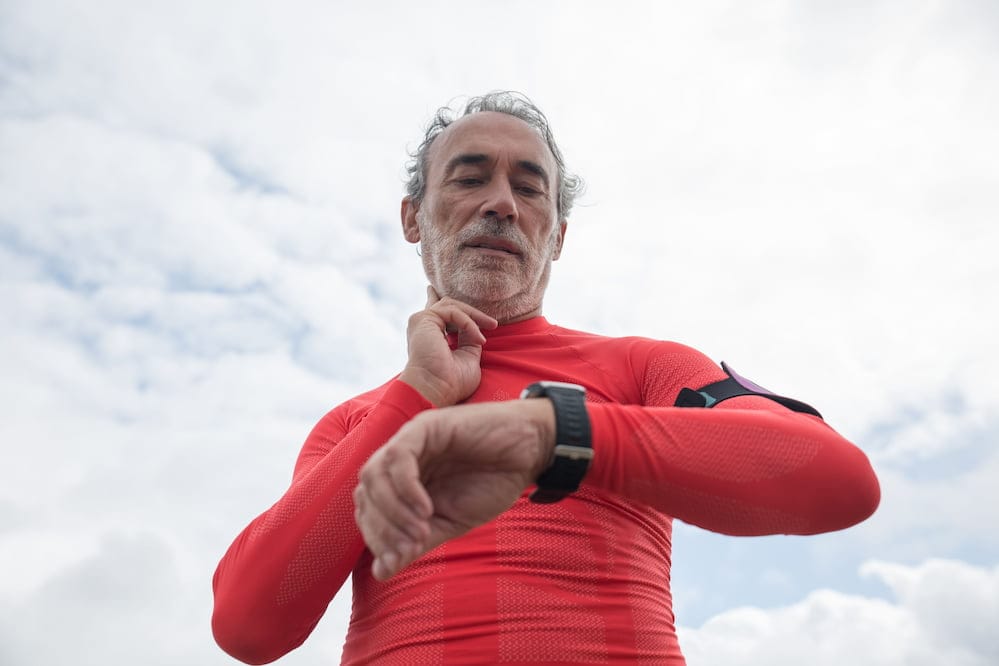
Do you need to train by heart rate at all?
Knowing your heart rate helps you match each run to its actual purpose, whether that is building endurance, improving speed, or staying in a true recovery zone. Without that feedback, it is easy to train at the wrong intensity for years, running too hard on most days and then wondering why race results are not improving.
That said, you do not have to. Plenty of accomplished runners never use a heart rate monitor. Effort and the talk test work perfectly well as a guide: if you can speak in full sentences, you are somewhere around zone 2, and if you can manage a few words, you are near zone 4.
What heart rate gives you is objectivity on days when you misjudge your own effort, because a number on your wrist argues back in a way that feelings do not.
The sensible approach uses both. Set the zone, then check it against how the run actually feels. When the two disagree badly, trust the effort and look for the reason afterward, since heart rate responds to heat, sleep, caffeine, and stress as much as to pace.
Related: How to Lower Your Heart Rate While Running
Frequently asked questions
Is zone 2 the fat-burning zone?
You do burn a higher share of fat at that intensity, though a higher share of a smaller total. Over a full day, what decides fat loss is how much energy you use altogether and what you eat, not the zone you ran in.
Why does my heart rate climb during a long run at the same pace?
That is cardiac drift, and it is normal. As you lose fluid and your body temperature rises, your heart beats faster to do the same work. On long runs, hold the effort steady and let the number drift.
Chest strap or wrist monitor?
A chest strap reads the electrical signal from your heart and is more accurate, especially during intervals and in cold weather. Wrist sensors read blood flow through the skin, which is convenient and good enough for easy and long runs, where the pace does not change much, though they can lag or misread during speed work like intervals.
Why does my watch show different zones?
Many watches calculate zones from your heart rate reserve, which is the gap between your resting and maximum heart rate, rather than from your maximum alone. This is called the Karvonen method, and it usually puts each zone about 10 to 15 beats higher than the percentages above. Neither approach is wrong, so pick one and stay with it, since mixing the two is what causes the confusion.
What is a good average heart rate for running?
There is no single right number, because it depends on your age, your fitness, and how hard you are running. Many adults average somewhere between 120 and 150 beats per minute on an easy run, though plenty of people fall well outside that. Your own zones tell you far more than any average.
What heart rate should most of my runs be at?
Zone 2. If your easy runs regularly leave you unable to talk in full sentences, they are too fast.
What zone should a long run be in?
Zone 2, the same as your other easy runs. Your heart rate may rise at a steady effort as the miles add up, as explained above.
Do my zones change with age?
Your maximum heart rate falls by roughly one beat a year, so the numbers behind each zone come down slowly. The percentages themselves stay the same, and recalculating every few years is enough.
My heart rate is always high. Is something wrong?
Maximum heart rate varies widely between people of the same age, and a naturally high reading is common. If it stays unusually high on easy runs despite good sleep and recovery, or comes with unusual fatigue, it is worth a check with a doctor.