Table of Contents
Dark toenails are almost a rite of passage for runners. You peel off your socks after a long run and find a nail gone purple, black, or lifting at the edge. It looks alarming the first time, and many runners assume the worst. Runners even have a name for it, runner's toe.
Below, we'll explain what a black toenail really is, what causes it, and how to prevent it.
What runner's toe is
A black toenail is bleeding trapped under the nail, and doctors call it a subungual hematoma. Runners know it as runner's toe.
The cause comes down to simple mechanics. Each time your foot lands, your toes slide forward and tap the front of your shoe. One tap does nothing, but thousands of taps on a single run can bruise the nail bed, break tiny blood vessels, and leave blood pooled under the hard nail. That trapped blood turns the nail black, red, or purple, and the pressure can lift it away from the skin underneath.
Because the nail is hard and cannot flex, the blood has nowhere to escape, which is why the mark can take months to grow out. Sometimes the nail throbs, and sometimes you feel nothing and only notice the color days later.
The big toe takes the worst of it for most people, since it is usually the longest. If your second toe is longer, a common foot shape called Morton's toe, that nail may go dark instead.
The shape of the shoe matters as much as its length, because a narrow, pointed toe box adds pressure even when the size is right.
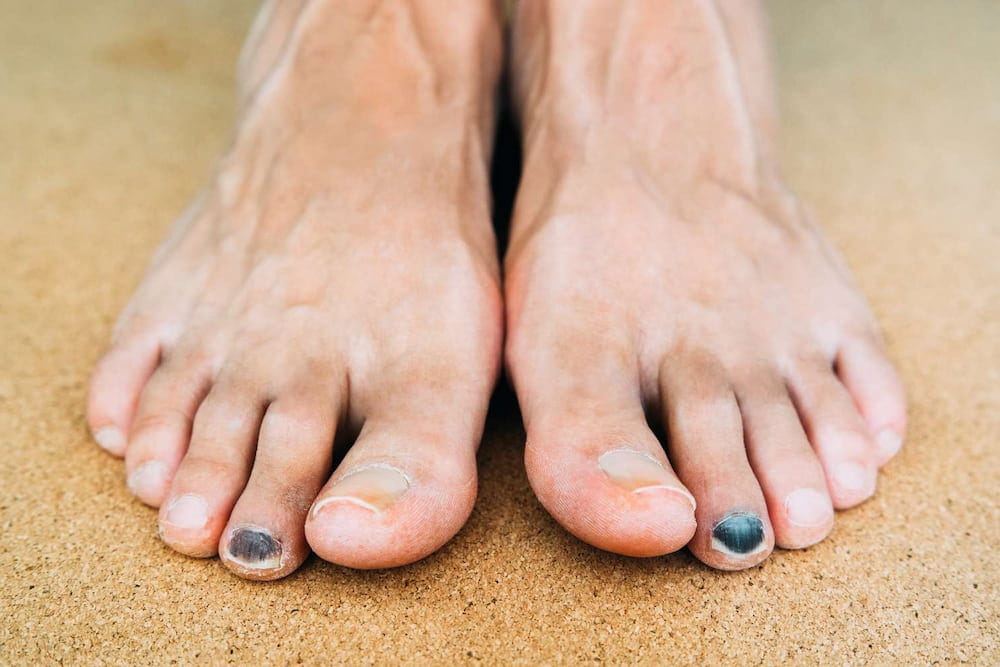
What causes a black toenail
Several things push your toes into the front of the shoe and raise your chances of a black toenail:
- Running downhill, which jams your toes forward
- Feet swelling on long runs, so your shoes get tighter
- Toenails left too long, which catch the top of the shoe
- Shoes that are too short, or too narrow through the toe box
- Shoes too loose through the midfoot, letting your foot slide
- Big mileage with little recovery for the nail
Black toenails are common, and they show up most after long races and heavy training blocks. The damage also builds up over weeks, so a nail can darken from steady training even without one obviously bad run.
Related: 5 Running Shoe Mistakes That Cause Injuries

6 ways to prevent black toenails from running
You can stop most black toenails with a few changes to your shoes and routine:
- Get the right shoe size. Leave about a thumb's width (1 cm) between your longest toe and the front of the shoe. Feet swell as you run, so fit for your bigger, end-of-run foot.
- Trim your nails straight across. Keep them short so they cannot press into the top of the shoe, and smooth any sharp corners.
- Wear moisture-wicking socks. Dry feet slide less, so your toes stay in place and do not drift into the front.
- Try heel-lock lacing. Anchoring your heel with the top eyelets stops your foot from sliding forward, which helps most on downhills.
- Protect a sore toe on long runs. A little lubricant or a soft cap over a tender nail cuts the friction.
- Build mileage slowly and control downhills. Give your feet time to adapt, and hold your pace back on steep descents where much of the damage happens.
If black toenails keep coming back, a fitting at a running store can catch a size or shape problem you have missed.
Can you lose the whole toenail?
Sometimes, yes. A black toenail does not always fall off, and many grow out dark and recover on their own. When the bruise underneath is large, though, the nail can lift and eventually come away from the toe. That looks dramatic, yet it is rarely a real problem.
If the nail does come off, it almost always grows back. A big toenail can need 6 to 12 months to return fully, and smaller nails come back faster. The new nail may look ridged or thicker at first, and it usually smooths out as it grows. After years of repeated knocks, a nail can grow back permanently thicker or a little misshapen, which is harmless even when it looks different.
While it heals, resist the urge to pull off a nail that is lifting. Let it fall away on its own, and keep the toe clean and covered so the skin underneath stays protected. A lifted nail can let in fungus, so dry your feet well and change out of damp socks. See a professional if the toe grows red, swollen, or leaks fluid, since that can point to an infection.
Overall, a black toenail with no pain needs nothing beyond patience, and it will either grow out or drop off in its own time. Most runners get one at some point and forget about it once it clears. Keep your shoes fitted and your nails trimmed straight across, and you will see far fewer of them.
Frequently asked questions
Do black toenails always fall off?
No. Many grow out dark and recover without ever coming off. The nail lifts and drops only when the bruise underneath is large, and even then it almost always grows back.
Should I pull off a loose black toenail?
No. Let it detach on its own. Pulling it early exposes the tender skin underneath and raises your infection risk. Keep it covered until it comes away naturally.
Should I drain a black toenail myself?
Better not to. Draining relieves the pressure, but doing it at home invites infection. If the pressure is very painful, have a professional release it in clean conditions.
Can I keep running with a black toenail?
Usually yes, if it is not painful. A dark nail with no real pain is mostly a cosmetic issue. If there is throbbing pressure, ease off and have it looked at.
Are black toenails a sign my shoes are too small?
Sometimes, though not always. Short shoes are one cause, and so are downhill running, long toenails, and feet sliding forward on long runs. Check your fit first, then your lacing and nail length.