Table of Contents
No pace is too slow to count as running. As long as there is a moment when both of your feet leave the ground at once, you are running, even if someone could walk faster beside you. Running is defined by how you move, and pace has nothing to do with it.
In this article, we’ll have a look at what separates running from walking, why slow running is nothing to apologize for, and whether every run should be slow.
What counts as running?
The line between walking and running has nothing to do with speed. It comes down to what your feet do between steps.
When you walk, one foot is always on the ground, and for part of each step both feet touch down together. In fact, during walking both feet share the ground for about a fifth of every step, and that shared contact is exactly what running removes.
When you run, every stride includes a flight phase, a brief moment when both feet are off the ground.
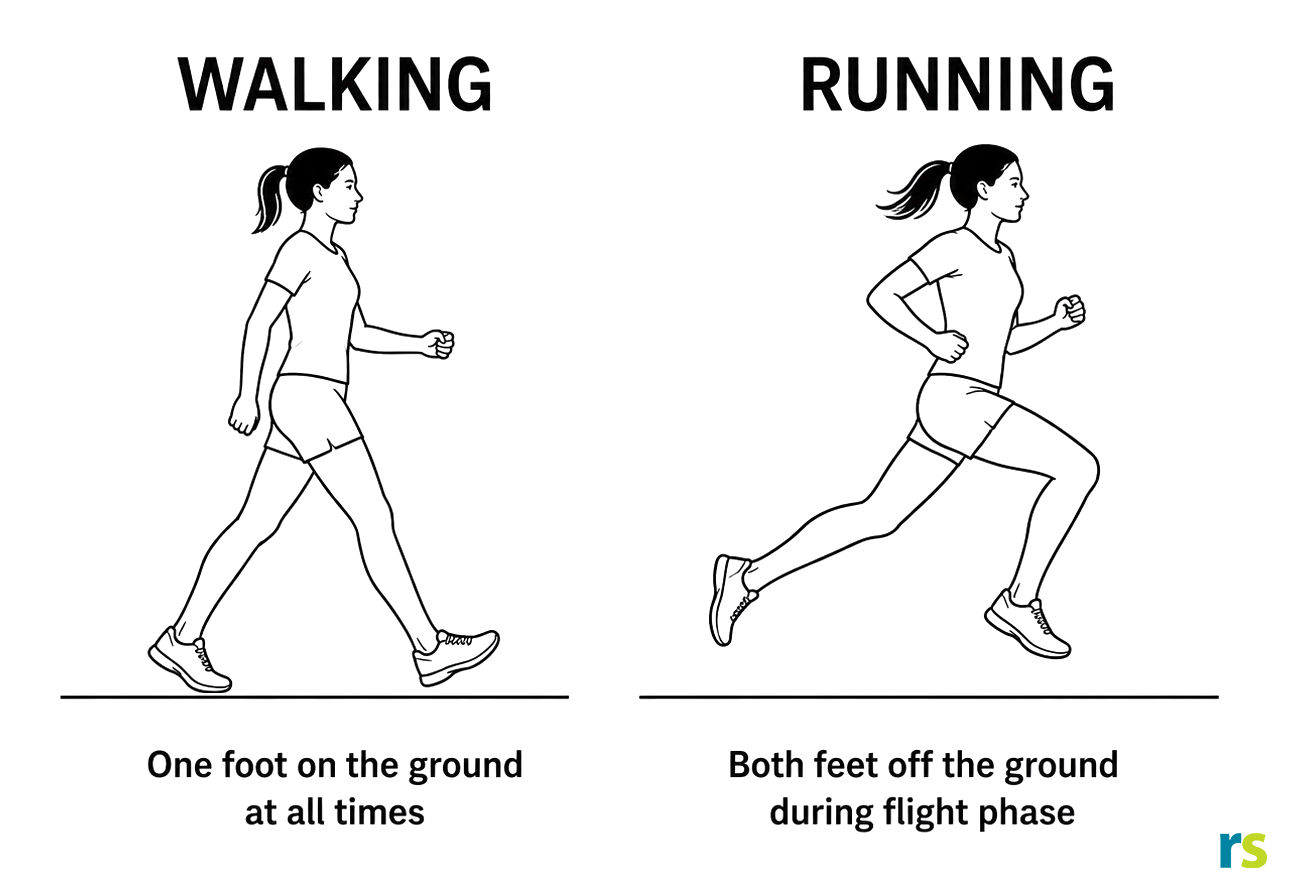
That flight phase is the whole difference. A slow, shuffling jog still has it, which makes it running. A fast, powerful walk never does, which keeps it walking, no matter how quick it looks. After all, racewalkers can move faster than many joggers while staying, by definition, walkers, because one foot always stays in contact with the ground.
Is any pace too slow to count as running?
No. You can run as slowly as you like and it still counts.
Most people naturally switch from walking to running at around 4.5 miles per hour (7.2 km/h), or about a 13-minute mile (8:00 per kilometer), because running becomes the more comfortable choice above that speed. Below it, walking feels easier, so slowing to a crawl can feel awkward. Awkward is not the same as invalid.
There is a reason very slow running feels clumsy. At walking speeds your legs swing like a pendulum and cost little energy, while running at the same speed asks your muscles to lift and lower your whole body with every stride. So a slow jog can burn more energy than a walk at the same pace, which is part of why it feels harder to hold.
If you keep that flight phase, a 14- or 15-minute mile (roughly 8:45 to 9:20 per kilometer) is still a run.
Plenty of new runners, older runners, and anyone coming back from injury spend time at paces a brisk walker would beat. They are running, and it is doing them good.
The slow shuffle even has a name among runners, the ultra shuffle, used by ultramarathoners to cover 100 miles while barely lifting their feet.
5 reasons slow running is good for you
Slow running is not a lesser version of the real thing, but the foundation that most good training is built on.
Elite runners spend around 80% of their miles at an easy, conversational pace, a pattern the sports scientist Stephen Seiler called the 80/20 rule and the coach Matt Fitzgerald wrote a whole book about.
Here's why easy running matters so much:
- It builds your aerobic base.
Easy running increases the energy-producing parts of your muscle cells and adds small blood vessels, so your body takes in and uses oxygen better. This is the biggest driver of endurance. - It lowers your injury risk.
Slow miles load your body gently, so you can run more often without the pounding that sidelines faster runners. - It lets you run more.
Because easy runs do not leave you exhausted, you can add the weekly volume that builds real fitness. - It speeds up recovery.
A gentle jog the day after a hard session brings blood to tired legs and helps them recover. - It makes your hard days count.
When most of your running is easy, you reach your fast workouts fresh enough to push, so the hard days do their job.
And this holds for everyday runners too, not just elites, since the same easy-hard split that works for Olympians helps a weekend runner build fitness with less burnout.
Should all your runs be slow?
Slow running builds the base, however, if you want to progress, run faster, or race for a time, you also need a smaller dose of hard running, the other 20%. That is where tempo runs and interval sessions come in, teaching your body to hold quicker paces on race day.
The mistake most runners make is the reverse of going too slow. They run their easy days too hard and their hard days too easy, so everything blurs into one moderate effort. Keep your easy runs truly easy, and you earn the freshness to run your hard days hard.
Beginners and returning runners especially benefit from keeping nearly everything slow at first, adding hard efforts only once the easy running feels comfortable.
How to tell your easy runs are easy enough:
- You can talk in full sentences the whole way
- Your breathing stays relaxed, never ragged
- You could keep going well past when you stop
- You finish feeling like you could do it again
If your goal is to enjoy running or stay healthy, you can run slowly forever and never touch a fast workout. If you want to race or set a personal best, keep most runs easy and add a little speed each week.
Frequently asked questions
Does running slowly still count as exercise?
Yes. A slow run gives your heart, lungs, and legs a real workout, often more than a brisk walk. The health benefits of running hold up even at gentle paces.
Will slow running make me faster?
It can, especially combined with a little speed work. Easy miles build the aerobic base that faster running is built on, which is why most elite runners do the bulk of their training slowly.
How slow is too slow for a beginner?
There is no pace too slow. Beginners should run at a pace where they can hold a conversation, however slow that turns out to be. Speed comes later, from consistency.
What is the difference between jogging and running?
Mostly the words themselves. Both have a flight phase, so both are running by definition. "Jogging" usually just means running at an easy, relaxed pace.