Table of Contents
This article covers what a typical half marathon time looks like: the worldwide averages, the official figures from the biggest races in the United States, what counts as a fast time among amateurs and among the elite, and three ways to predict your own result.
Average half marathon time worldwide
The average half marathon worldwide takes about 1:59:30 for men and 2:14:20 for women.
Those figures are worked out from an analysis of 107.9 million race results, which publishes average pace for this distance: 9:07 per mile (5:40 per km) for men and 10:15 per mile (6:22 per km) for women over 13.1 miles (21.1 km).
Average finish times at the biggest US half marathons
In the United States the average comes out at about 1:59:35 for men and 2:17:37 for women, judging by the two biggest half marathons in the country:
| Race | Men | Women | Overall |
|---|---|---|---|
| United Airlines NYC Half (2026) | 1:58:59 | 2:16:29 | 2:07:51 |
| RBC Brooklyn Half (2026) | 2:00:08 | 2:18:51 | 2:08:48 |
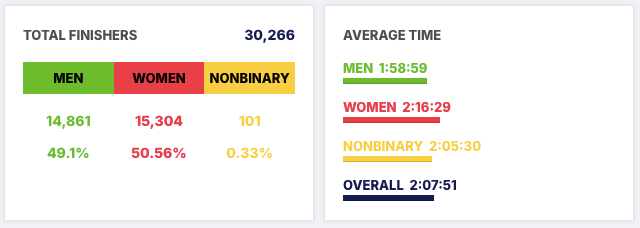
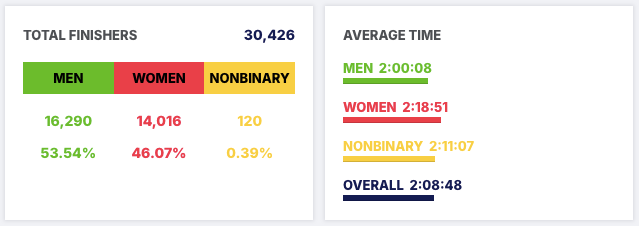
Those two overall averages are 57 seconds apart. The races were run two months apart in very different weather (at 36°F/2°C in March and 61°F/16°C in May), and the fields still came out almost level.
Both averages cover everyone who crossed the line, from club runners chasing a personal best to people finishing their first long race. Keep in mind that both races are big-city events held in spring, on fast courses that runners enter by lottery. A small-town half marathon in August produces slower numbers.
What counts as a fast half marathon time
Among recreational runners, breaking two hours is the time that earns respect. Sub-1:45 is a strong result, and anything under 1:30 counts as fast.
Elite half marathon times are from another planet:
- Men: Yomif Kejelcha, 56:51, Buenos Aires, August 2026
- Women: Letesenbet Gidey, 1:02:52, Valencia, October 2021
The mark Kejelcha took down was barely less remarkable. Jacob Kiplimo ran 57:20 in Lisbon five months earlier, and in Barcelona in 2025 he ran 56:42, quicker than anything above. World Athletics could not ratify that one, because the race fell short of its rules.
How to predict your half marathon time
If you have already raced a 10K and want to take on a half marathon, there are three ways to work out what you might run.
1. Use a formula
The table below uses Riegel's formula, the standard way of estimating a time at one distance from a result at another, and gives you a target straight away.
| Your 10K time | Likely half marathon |
|---|---|
| 45:00 | 1:39:17 |
| 50:00 | 1:50:19 |
| 55:00 | 2:01:21 |
| 1:00:00 | 2:12:23 |
| 1:05:00 | 2:23:25 |
| 1:10:00 | 2:34:27 |
2. Use your long runs
Your long runs show what you can already sustain for an hour and a half or more, which is something a 10K result cannot tell you.
Go out for 10 miles (16 km) at a comfortable pace, the kind where you could still hold a conversation, and write down the pace you held. On race day, most runners hold about 20 to 30 seconds per mile (12 to 19 seconds per km) quicker than their comfortable long run pace.
For example, a 10-mile run at 11:00 per mile (6:50 per km) points to a half marathon at around 10:35 per mile (6:35 per km), which comes out near 2:19.
3. Use a calculator
For a third figure, run your 10K result through a VDOT calculator. It converts between distances the same way, and it returns your training paces alongside the prediction, so you get a plan and not just a number.
What your half marathon time predicts
A half marathon result converts cleanly across the whole range of road distances, which is why coaches treat it as the single most useful time to have on record.
| Half marathon | 5K | 10K | Marathon |
|---|---|---|---|
| 1:30:00 | 19:34 | 40:47 | 3:07:39 |
| 1:45:00 | 22:50 | 47:35 | 3:38:55 |
| 2:00:00 | 26:05 | 54:23 | 4:10:12 |
| 2:15:00 | 29:21 | 1:01:11 | 4:41:28 |
| 2:30:00 | 32:36 | 1:07:59 | 5:12:44 |
The half marathon is the most popular of the long distances. Worldwide the typical finisher comes in around 1:59:30 for men and 2:14:20 for women, and both of those are within reach of a few months of consistent training.
If you have never covered 13.1 miles before, start with our tips for running a half marathon without stopping.
And if the distance is already familiar and you want your next one to be something more ambitious and memorable, look through our list of the most epic half marathons in the world.
Sources
- Worldwide pace figures: RunRepeat, The State of Running, an analysis of 107.9 million race results from about 70,000 events. Finish times over 13.1 miles are converted from the published average paces.
- Average finish times and finisher counts for the 2026 United Airlines NYC Half and the 2026 RBC Brooklyn Half: official race statistics published by New York Road Runners.
- World records and ratification status: World Athletics.
- Both conversion tables: calculated with Riegel's formula, published by Peter Riegel in 1977 and used in most race-time calculators.