

Sometimes, a single run can change everything.
These 10 stories are about people who once stood on the edge: of illness, addiction, loss, loneliness, or despair. And they found a way out through movement.
Some started with 15 seconds on a treadmill. Others hit the track with a prosthetic leg or a newborn in their arms and a body that had just given birth. Each of them had a different path, but all were united by one thing—the desire to truly live.
For them, running became more than just exercise. It was a lifeline. A chance to start again. A way to meet themselves anew.
Maybe you're facing your own mountain. Read these stories. Let them remind you: no matter where you begin, every step counts.
1. Jacky Hunt-Broersma, a cancer survivor and amputee, is known for running 104 marathons in 104 consecutive days
Running wasn’t just a choice for Jackie Hunt-Broersma—it became her revolution.
At 26, she lost the lower half of her left leg to Ewing’s sarcoma, a rare form of cancer. Fourteen years later, in 2016, she put on her first pair of running shoes and ran her first 5K.
Since then, she has become one of the most accomplished amputee ultrarunners in the world.
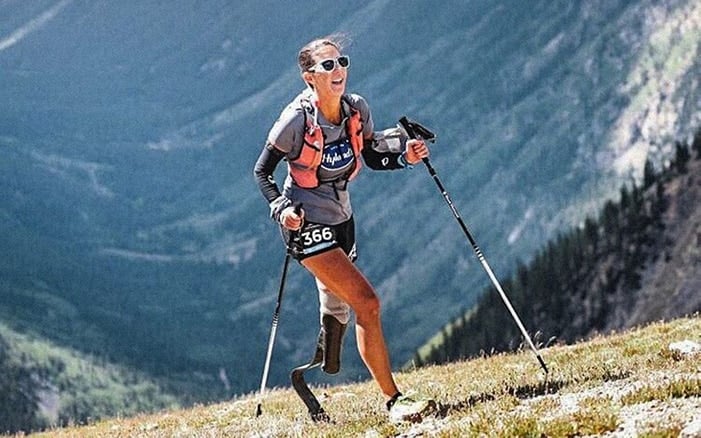
In 2022, she set a world record by running 104 marathons in 104 consecutive days, raising $194,000 for a foundation that helps amputees get prosthetic limbs.
That same year, she became the first amputee to run 100 miles on a treadmill in under 24 hours—in 23 hours and 38 minutes.
In 2023, she surprised the world again by running 250 half marathons in 250 consecutive days, dedicating each race to people facing cancer.
Jackie became the first amputee to complete the brutal TransRockies mountain race (120 miles in 6 days and 20,000 feet of elevation gain) and the technically challenging The Naturalist 25K in Franklin, North Carolina.
Every time Jackie ran, it became something bigger than a race—a way to heal, to give, to lead. It’s an act of strength, mindfulness, and support for others. After her diagnosis, she asked herself, “Why did this happen to me?” and found the answer in helping others.
“I ran 104 marathons for those who can’t,” says Jackie. “For those who dream of running again. For those who are battling cancer and feel alone. I wanted them to know they are not alone.”
Jackie's example inspires the running community and countless others around the world—especially those living with serious illness or disability. Her story proves that even after amputation, even after a devastating diagnosis, life can still be full of meaning, adventure, and victories.
2. Ben Davis, losing 200 pounds, one step at a time
When Ben Davis was 22, he weighed over 350 pounds (158.8 kg), spent his days at home playing video games, and tried to stay out of sight. He didn’t go jogging, he didn’t eat healthy, he wasn’t happy.
But one day, everything changed—not with a magic pill, not with a trendy program, but with one decision: to take charge of his life.
It all started with a simple family question, “How are you doing?, from his grandmother on Christmas Day 2008. As usual, he answered, “Fine.” Only this time, it hurt him. He suddenly realized that he wanted it to be true.
That same night, he started a blog, “Ben Does Life,” on Tumblr and promised his grandmother that one day he would fit into the shirt she gave him, a size XL, two or three sizes smaller than his actual size. That was his starting point.
Together with his brother Jed, a football coach who also struggled with excess weight, he started running. First, a few steps. The next day, a little further. A month later, the first 5K runs. A year later, full marathons.
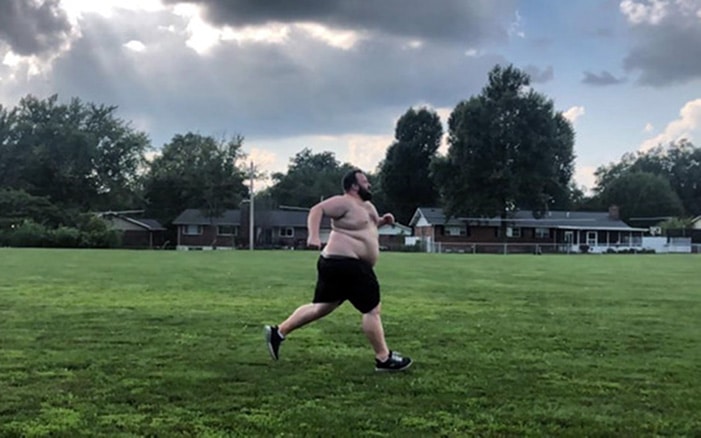
And although times were tough, “In the beginning, I almost passed out by the end of the run,” Ben recalls, he kept going.
He also changed his diet: instead of pizza, he began eating oranges and simple food. He limited his calorie intake to 2,000 a day, gradually bringing his weight down to 247 pounds (112 kg), then to 220 pounds (100 kg), and then even lower. And all this—without a coach or nutritionist, just with the desire to change his life and honesty with himself and the audience.
The audience loved him precisely for his sincerity. Ben shared everything: fears, failures, victories, self-irony. His slogan, “Do life”, became an inspiring symbol for thousands of people who were also trying to change something in their lives. Some were struggling with excess weight, others with addictions or depression.
Today, Ben is a marathon runner, speaker, blogger, and author, and someone who continues to run and inspire. He has received letters from people all over the world, from people who went for their first run after reading his posts to those who got his slogan tattooed on their bodies.
“Do life” is not just about sports. It’s about choosing to live. About changing one part of your life, which pulls everything else along with it,” says Ben.
Be inspired: 10 Running Records That Will Blow Your Mind
3. The Hoyts, a family’s bond through running
The story of Team Hoyt is one of the most moving and inspiring stories in the history of running, a story of a father's love for his son, of overcoming the impossible, and of the strength of the human spirit.
Dick Hoyt and his son Rick Hoyt from Massachusetts became known around the world as a unique duo. Rick was born with cerebral palsy and used a wheelchair.
Despite this, his father Dick pulled, carried, and pushed him through marathons and triathlons. They started racing together after Rick once told his father, “Dad, when we run, I don’t feel disabled.”
Rick was born in 1962 with cerebral palsy after his umbilical cord became wrapped around his neck, cutting off his oxygen supply. Doctors advised his parents to send the child to a specialized institution, claiming that he would be a"vegetable." But his mom and dad saw something more in his eyes—intelligence and a thirst for communication.
Rick's mother, Judy, spent hours with him, using textured letters and sticking the names of objects on the walls. At age 11, Rick was given a special computer that he could use to communicate. It turned out he was highly intelligent, and he soon began attending a regular school.
In 1993 he graduated from Boston University with a degree in special education.
It all started in 1977 when Rick asked his father to run a charity race with him to support a paralyzed classmate. Dick was 36 years old at the time and was not a runner, but he agreed. After the first race, Rick said the very phrase that changed everything.
From that day on, Dick began training. While Rick was at school, Dick trained by pushing a wheelchair loaded with a bag of cement. Soon he became so resilient that even with his son in the wheelchair, he ran 5K in 17 minutes!

As of 2016, Team Hoyt has competed in 1,130 events! 72 marathons, including 32 Boston Marathons, 257 triathlons, including 6 Ironmans, 97 half marathons, 176 5K races, and even a bike ride across America—3,735 miles in 45 days.
Dick pulled Rick in the boat during the swims, carried him in a special tandem during the bike portions, and pushed him in a wheelchair during the runs.
In 2014, they officially completed their last Boston Marathon together. Since 2015, Rick has been assisted by their friend, dentist Brian Lyons, who passed away in 2020.
Dick Hoyt passed away in March 2021 at the age of 80, and Rick passed away in May 2023 from breathing complications. He was 61.
A bronze statue was erected in their honor at the start of the Boston Marathon in Hopkinton.
And, most importantly, they are forever etched in the hearts of millions of people around the world.
4. Simon Wheatcroft, a blind runner who uses technology to run marathons
Simon Wheatcroft from the UK is a man who, despite being completely blind, runs marathons, ultramarathons, and even 100 miles in the desert. His story is as much about willpower as it is about the future of inclusive technology that can change the lives of millions of people.
Simon began to lose his sight at the age of 17 due to a rare genetic disease: retinitis pigmentosa. Over time, he became completely blind but refused to put up with limitations. After an emotional blow when he was unable to climb to the top of a mountain in Yosemite to propose to his girlfriend, Simon realized that he needed to change something.
The solution was to run away. Literally.
He began training in the schoolyard, running laps around the soccer field, focusing on the texture of the grass. Later, he moved to an abandoned road near Doncaster Airport, where, having memorized every crack, he learned to run, feeling the markings under his feet.
He wrote to brands, asked for sneakers—he had no money, only a dream.
After six months of training, Simon went to his first 100-mile race. He was pulled out at mile 83, but he did not stop.
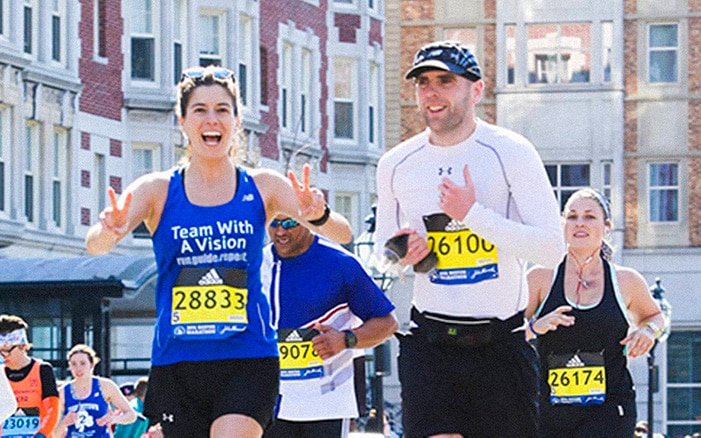
In the following years, he ran marathons in New York and Boston, participated in an ultramarathon in the Namibian desert, and covered the distance from New York to Boston—220 miles (354 km) in 9 days.
Simon became an active participant in the development of new solutions for visually impaired people. Together with the startup WearWorks, he tested Wayband—a tactile navigator that works on the principle of GPS and vibration. Instead of sound commands, the device "guides" the runner with the help of light vibrations: short ones—turn left, long ones—right.
An ultrasonic device called Tortoise was worn on the chest and warned of nearby objects. This allowed Simon to run on crowded courses, avoiding other runners and obstacles, all on his own, without the help of a guide.
In 2017, Wheatcroft set a goal: to become the first blind person to run the New York City Marathon unaccompanied. He trained with Wayband and Tortoise, refining every move. On race day, he was only accompanied at a distance, in case of unforeseen situations.
The first miles went perfectly. He passed groups of runners and dodged obstacles. But at mile 15, it started to rain, and the equipment malfunctioned. He had to return to the guide.
Nevertheless, Simon finished in 5 hours and 17 minutes. Tired but inspired, he said: “This is not a time trial. This is proof that more is possible than we think.”
5. Kayla Montgomery, ran through pain with multiple sclerosis, never gave up
Each of her races ended the same way: Kayla Montgomery would finish and immediately collapse, literally into the arms of her coach, unable to stand any longer. Her legs felt like strangers. She couldn’t feel them and couldn’t control them.
This is not a figurative expression. Kayla had multiple sclerosis—an autoimmune disease that affects the nervous system and prevents signals from reaching the brain from the body. When her body overheated while running, the connection with her legs disappeared. But she kept running because running was her freedom and meaning.
It all started after a fall during soccer practice. Doctors couldn’t make an accurate diagnosis for a long time—they excluded one thing after another until multiple sclerosis was confirmed. For a teenager, this was a shock. Kayla avoided talking about the disease, even with her parents, pretending that everything was fine. But the fear and loneliness only grew.
“I tried to live my life as before, but inside I was so scared,” she recalled.
Eventually, after a course of treatment that made the numbness temporary, Kayla decided to take advantage of every opportunity. She returned to running, despite the risk: every start could end in a fall and a complete loss of control over her body.
“I wasn’t the best on the team, but I trained as hard as I could. It was important to me to be ready if I was needed,” shesaid.
Her persistence paid off: Kayla won the state championship in the 3,200 meters, set records, and became captain of the school team.

She later enrolled in an NCAA Division I university, where she ran for the national team and studied molecular biology. She continued to train six days a week, covering up to 75 miles per week.
Since she couldn’t feel her legs, she learned to navigate the movement of her arms to control her pace and technique.
“Long distances were my favorite. You had to be strong and resilient. I loved testing myself,” she said.
Kayla had gone through what would have been the end for many. But for her, illness was a boost.
“Running made me happy. As long as I was running, I was okay. It made me feel whole and safe. I was running, so I was alive,” she said.
6. Catra Corbett, from addiction to ultrarunning
She once lived on the edge. Drug addiction, eating disorders, broken relationships with her family, and an arrest. Catra Corbett remembers it as a “death spiral.” But one day she said to herself, “I don’t want to be an addict anymore,” and started over. And she hasn’t stopped since.
Today, Catra is an ultrarunner who has completed over one hundred 100-mile races, set course records, and become an inspiring voice in the addiction recovery and mental health fields. Her life is proof that even from the deepest darkness, it’s possible to rise—if you keep moving forward.

Before she became a runner, Catra was a very different person. She worked as a hairdresser and go-go dancer, made friends, partied—and did meth, living only for the next fix. She dropped out of school, broke relationships with loved ones, and eventually ended up in prison.
That’s when she realized she’d hit rock bottom. That was the beginning of the climb. First, sobriety. Then, the gym. Then, running.
Catra never liked running. But she remembered her father, who died when she was 17, once telling her that long-distance runners can go through pain and achieve the impossible.
One day, she just went for a run.
And she ran.
Now, Catra is one of the few people on the planet who has finished more than 100 100-mile races. Many call her passion for running "the new addiction." But she disagrees:
"It's not like drugs. I don't feel trapped. I choose to run, and that's what makes the difference."
She would call her life "Reborn on the Run", that's the title of her book.
"Running gave me a new life. It gave me strength, hope, and freedom. I became myself — on the run."
7. Janette Murray-Wakelin, 366 marathons after cancer
366 marathons. 366 days. 9,809 miles (15,782 km). This is not an advertisement for a movie, but a real story of an Australian couple, Janette Murray-Wakelin and Alan Murray.
At the age of over 60, they ran across Australia without a single day off. They did it on 100% raw plant food, without drugs or stimulants, wearing minimalist barefoot-style shoes. And it all started with… a diagnosis: cancer.
When Janette was diagnosed with breast cancer with metastases in the lymph nodes and chest wall, doctors gave her 6 months to live. She refused chemotherapy and chose a different path: recovery through nutrition, movement, and work with the body and mind.
Janette built her healing as an integral system. She didn't just change her diet, she completely rebooted her life.
A complete transition to a 100% raw food diet: fresh fruits, vegetables, juices, greens, wheat grass. Daily training: running, yoga, breathing practices. Ozone therapy, infrared sauna, visualization, and meditation.
Raw food gives the body nutrition, running gives oxygen. Together they created an environment in which cancer could not exist.
Six months after the diagnosis, which "left" her six months to live, she was officially declared cancer-free.
Together with Alan, who also changed his lifestyle and became a runner, they decided to inspire others. This is how the idea of running 366 marathons in 366 days was born, to show what the human body is capable of when combined with pure consciousness and living food.
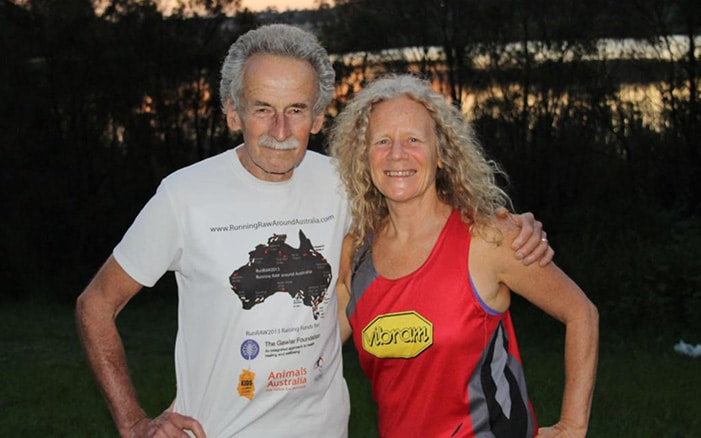
Running gave her strength, raw food gave her fuel, and mindfulness gave her direction.
“I didn’t just survive, I became stronger than ever. All of this was possible thanks to running and living food. Together, they gave me my life back.”
8. Fauja Singh, started at 89 and ran a marathon at 100
Fauja Singh is living proof that it’s never too late to start. A British Sikh of Indian descent, he took up running seriously… at 89. Since then, he has made history as one of the oldest marathon runners in the world, having completed dozens of races, including the London, New York, Toronto, and Hong Kong marathons.
What made him put on running shoes at such a venerable age? A personal tragedy. After the death of his son in 1994, he began running to cope with the grief. Soon, running became not merely an escape—it turned into a genuine passion, which grew into professional training and international competitions.
In 2003, at the age of 92, he ran the Toronto Marathon in 5 hours and 40 minutes—a record time for the 90+ age group.
In 2011, when Fauja turned 100, he completed the Toronto Marathon in 8 hours and 11 minutes, becoming the first person in history to finish at that age.
That same year, he set eight world records in a single day in the 100+ age group—at distances from 100 to 5,000 meters.
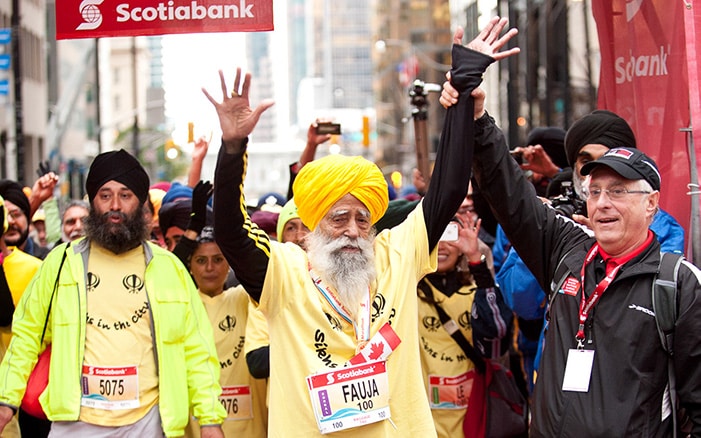
Fauja often said that “the first 20 miles are easy, and the last six are a conversation with God.”
His training was accompanied by strict discipline: he did not drink alcohol, did not smoke, adhered to a vegetarian diet, and went to bed with a prayer on his lips.
Singh became a symbol of inspiration all over the world. He was called the “Turbo Tornado.” He has appeared in Adidas adverts alongside David Beckham and Muhammad Ali, carried the Olympic torch in 2012, and received the British Empire Medal for his services to sport and charity.
9. David Clarke, from 320 pounds and addiction to ultramarathons and a new life
David Clarke was on the edge. A former multi-million dollar business owner, he had lost everything—his health, his control, his self-respect.
He weighed 320 pounds (145 kg), drank every day, and was dependent on painkillers. His business had collapsed, and his family had become estranged. His doctor told him straight out: “You could have a stroke within an hour.”
When he was too drunk to wrap his children’s presents one Christmas evening, he realized: this was no longer possible. The next morning, he said to himself: “Enough”—and this time it was real.
From that moment on, his transformation began—one of the most impressive in the history of running.
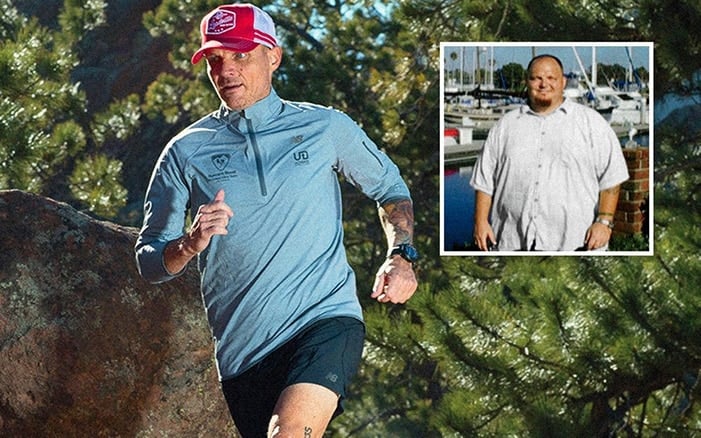
He returned to the gym, where he had been a member for 10 years, but had never showed up. He barely ran 15 seconds on the treadmill. But that was the beginning. He decided that if he could quit drinking and drugs, he could run.
A few months later, he had lost 130 pounds. He bought his first pair of running shoes and told the salesperson that hewanted to run a marathon.
With the support of the running community, David went far beyond weight loss—he became an ultramarathoner. He ran 29 ultras, crossed Colorado (340 miles / 547 km), and even created his own challenge—a quadruple Boston, in which he ran 104.8 miles (168.7 km) through the city’s streets in conjunction with the official marathon.
He did all this for others. He founded The Superman Project to inspire people who, like him, once felt lost—suffering from obesity, addiction, and injury. He wanted to show that anyone can be the hero of their own story.
“I want to help people do something that seems impossible, run a 5K, complete a marathon, climb a mountain. Because in it, a new life is born.”
David is the bestselling author of “Out There” and “Broken Open”, where he candidly shares his story of struggle and recovery. His latest book, “Eat Sh*t And Die”, is about food addiction and an honest conversation about his body, pain, and self-acceptance.
He built a life filled with meaning. He opened a gym, ate vegan, became a caring father, and an inspiration to thousands of people.
Sadly, in 2020, after complications during spinal surgery, David passed away. But his story lives on. His “start with 15 seconds” approach continues to change lives.
“Truth is not something we find outside. It has always been inside us. Running helps us hear it.”
10. Stephanie Bruce, elite runner and mom of two who returned stronger after childbirth
Stephanie Bruce is a US 10K champion, professional athlete, mother of three, and a woman who wasn’t afraid to show the real side of her postpartum comeback.
Stephanie’s pregnancies came one after another, with her sons born just 15 months apart. After her first birth, she experienced a difficult recovery: serious pelvic muscle damage, sleepless nights, emotional ups and downs.
Her first run after 7 weeks ended with a feeling like “my uterus was about to fall out,” and on her next run... she soiled her pants. Yes, this is not the kind of thing you usually talk about on Instagram, but it is this honesty that has made Stephanie a heroine for thousands of women around the world.
She found out that she had diastasis recti, a separation of the rectus abdominis muscles that many women experience after pregnancy. Instead of hiding it, she began to talk about it openly, posting photos of her belly with stretch marks and a “pouch” of skin, sharing her recovery progress. To her, running became both a path to physical recovery and a form of therapy.
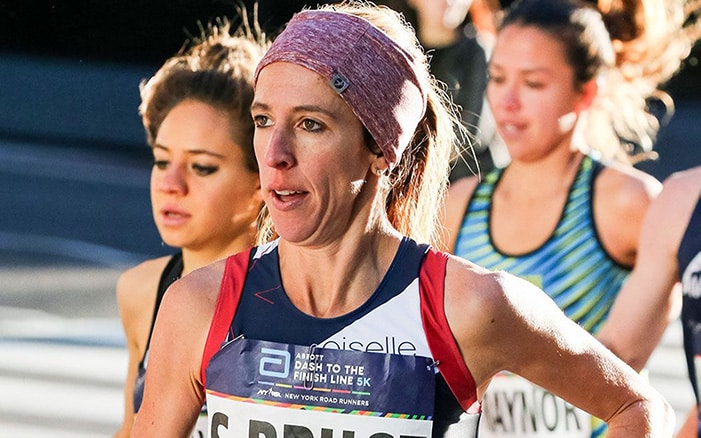
With the support of her husband, coach, team, and sponsor, Stephanie has been on a years-long journey. She made her comeback—and pushed her limits beyond what they’d been before.
She won the US National Half Marathon Championships with a personal best of 1:10:44, proving that a postpartum body is not a source of shame, but a symbol of strength.
Stephanie says: “I’m still working on rebuilding my abdominal muscles, and I may have to do that for the rest of my life. But my body is stronger than ever. I’m proud of it. It’s not what it used to be, but it can do the impossible.”
This story is a reminder: being strong doesn’t mean being perfect. Being a mom and a runner are not mutually exclusive. And true beauty is in honesty, courage, and running forward no matter what.
Each of these stories proves that real strength comes from the decision to keep going. You don’t need to be perfect. You don’t need to wait for Monday, springtime, or a wave of motivation. All you need is to take that first step—even a small, clumsy one, through tears or in worn-out sneakers.
By Lena Sage


