

The 10K is one of the most popular races in the world, with millions of runners lining up for the distance every year. Alongside the 5K, it’s often the first real benchmark for recreational runners before they move on to longer races.
But sooner or later, simply finishing stops being the goal. The question changes: how fast can you run it? What will it take to break 40 minutes, 50 minutes, or the one-hour barrier?
In this guide, we’ll look at what actually helps you set—or improve—your 10K PR, from structuring your training to pacing the race itself.
Here are 10 practical tips to help you run your fastest 10K yet.
1. Make the 10K your training priority
If your goal is a 10K PR, your training needs to be centered on that distance. In other words, avoid treating your goal race as a tune-up for a marathon, especially an ultramarathon.
Marathon prep demands significantly higher mileage, with long runs that often stretch beyond 12–20 miles (20–32 km) and extended tempo efforts. As a result, that kind of volume directly competes with the lower-mileage, speed-focused work that leads to a fast 10K.
So, if a marathon is on your calendar and a 10K falls in the middle of that build, you’re unlikely to run your absolute best while carrying that fatigue.
You might still run well, particularly if you’ve done consistent speed work, but your ceiling will be higher when the 10K is the main event and your training is structured around it.
Shorter races, on the other hand, fit naturally into a 10K cycle. For example, a mile can act as a checkpoint for raw speed, while a 5K can show how well you’re holding pace—both strong indicators of 10K readiness.
Related: How to Run Your Fastest Mile
To sum it up, you run your fastest 10K when you train for the 10K, not when you squeeze it into a marathon block.
2. Include workouts that improve your anaerobic threshold and speed endurance
The 10K is one of the most physiologically demanding distances, and to run it well, you need a strong anaerobic threshold and a high VO₂ max.
When you race a 10K for time, your pace typically sits slightly above your anaerobic threshold—roughly 80–90% of VO₂ max.
In practice, running 10K for a PR feels far from comfortable. Instead, it becomes a true speed-endurance challenge, where you have to hold a hard, fast pace while lactate continues to climb.
At the same time, the goal is not simply to suffer through the distance, but to stay in control of your pace from start to finish.
That’s why your training should include workouts that raise your threshold and improve your ability to sustain speed. In particular, alternating tempo runs, fartlek sessions, and tempo runs are especially effective.
Examples of workouts that target the anaerobic threshold:
• Alternating tempo run
Alternate 1 mile at tempo pace (just below 10K effort) with
1 mile 30–40 seconds per mile slower.
Continue for 4–6 miles of work.
• Fartlek
1 minute faster than 10K pace / 1 minute easy jog
2 minutes at 10K pace / 2 minutes easy jog
3 minutes at 10K pace / 3 minutes easy jog
Complete two full sets.
• Tempo run
Run 5K at 10K pace (comfortably hard). Plan this session about three to four weeks before race day.
Warm-up and cool-down are not included in the examples above, so be sure to add them to every workout.
3. Add VO₂ max training
VO₂ max is another key variable when preparing for a fast 10K or any longer distance.
In simple terms, VO₂ max is the maximum amount of oxygen your body can use during intense exercise. The more oxygen you can deliver to the working muscles, the more energy you can produce while running at high speed.
Genetics determine each person's VO2 max and their potential maximum. However, this metric can be developed through specific training.
Typically, VO₂ max workouts are performed at about 95–100% of your current maximum effort. That means running longer intervals at a very hard but controlled pace.
To reach this intensity, your training plan should include repeats of 400 meters or more with recovery between them. These workouts are also known as intervals.
Examples of workouts to develop VO₂ max:
- 10–12 × 400 meters with 2 minutes of recovery
- 5–8 × 800 meters with 2–3 minutes of recovery
- 5–8 × 1000 meters with 3 minutes of recovery
Run the intervals at a very hard effort (about a 9 out of 10 effort or roughly your 5K race pace). Recover with easy jogging or brisk walking until your breathing is back under control and your heart rate drops before the next rep.
4. Improve your maximum speed
Maximum speed matters for every distance, including the 10K. Short repetitions of up to 100 meters help develop your top-end speed, which determines how fast you can race. In addition, these reps help improve running form.
Because these efforts are very short, they don’t create the same fatigue as longer intervals. So, you can add them the day before a key quality session, such as a VO₂ max workout or a threshold run.
Example of a workout to improve maximum speed:
5–10 × 100 meters fast but relaxed, with
100 meters of easy jogging between repetitions.
Run these as smooth accelerations rather than all-out sprints, focusing on rhythm and light footstrike.
5. Do a test run to lock in your goal pace
Practicing your goal pace is another key session that should be included in your training plan. About three to four weeks before race day, schedule a test run of 3–4 miles (5–7 km) at your planned 10K pace. This will give you a clear idea of how comfortable that pace feels.
If you finish the run feeling like you could continue at the same pace, you’re on the right track. This test run also builds confidence: you arrive at the start line already knowing what your race pace feels like.
You can also run some segments of this workout slightly faster to explore your speed limits.
However, if you run 5K at your maximum, you won’t have the energy for the remaining 5K of the race. That’s why this session is the right time to dial in a realistic target pace for the start.
6. Train according to a plan—preferably with a group
Speed work is an important part of your preparation, but a good training plan is not limited to it. It should also include easy recovery runs, long runs, and strength training.
Most importantly, your workouts shouldn’t be isolated. They need to work together towards one goal and follow a clear progression.
To avoid overtraining, make every third or fourth week a deload (cutback) week by reducing both volume and intensity.
Download: 10K Race 8-Week Training Plan
There’s one more thing to consider if you want better results: joining a run club or training group. Running with partners at a similar level, ideally slightly faster than you, gives you someone to chase and helps you improve your performance.
In addition, tough interval or tempo sessions almost always feel easier in a group, which directly affects your perception of effort.
A workout that feels like a 9 out of 10 on your own might feel like a 7 or 8 with others. As a result, you finish the session less fatigued and more fulfilled.
7. Choose a race with comfortable weather and a fast course
Beyond training, external factors can also influence your 10K performance—most notably the weather and the course itself.
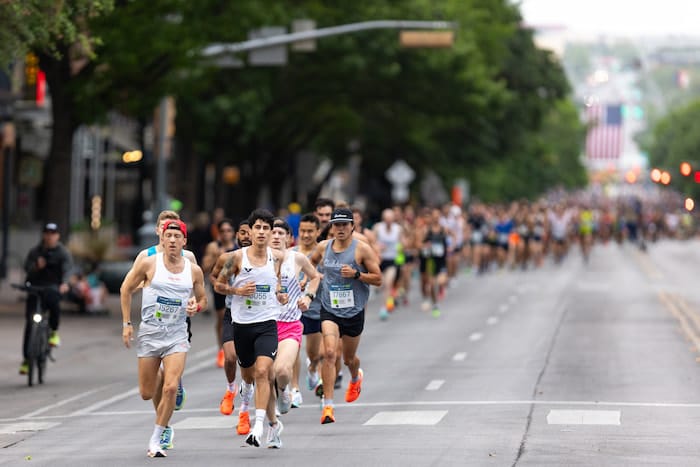
You can’t control race-day conditions, but you can take into account how well you tolerate heat and cold and choose your race date accordingly. For example, an early spring or late fall race, or a summer night run will usually offer more comfortable conditions for setting a personal best.
The race course is a more predictable factor. If you know the route has minimal elevation gain and few sharp turns or switchbacks, don’t hesitate to sign up.
8. Taper properly for race day
One week is enough to taper for a 10K. The goal is to gradually reduce volume and let your body absorb the training.
Your final hard interval session should be done about 10 days before the race. For example, if you’re racing on a Saturday, schedule that workout between Wednesday and Friday of the previous week.
Another key rule of race week is simple: nothing new. This applies to your nutrition, gear, and especially your training. Everything should feel familiar and predictable.
During the taper, avoid hard or unfamiliar workouts. The priority is to protect the fitness you’ve already built and arrive at the start line feeling fresh, not tired.
Easy runs plus a short speed session are more than enough. For example:
• 8–10 × 200 meters fast but controlled, with 200 meters easy jog or
• 8–10 × 300 meters fast but controlled, with 300 meters easy jog or
• Pyramid workout:
3 × 200 meters / 200 m jog
2 × 400 meters / 200 m jog
3 × 200 meters / 200 m jog
Each repetition is followed by relaxed jogging, just enough to recover before the next one. These sessions shouldn’t feel all-out. Save your full effort for race day.
Be sure to include several rest days during the week. The day before the race, you can either do an easy 5K or take the day off completely.
On race day, warm up with 10–15 minutes of easy jogging and finish with 5–6 short strides to wake up your legs and gradually bring your heart rate up.
9. Run with a pacer or find your race pack
Many 10K races offer pacers—experienced runners who hold an even pace to guide others to a specific finish time. You can usually spot them by a flag, sign, T-shirt, or bib that shows the target result.
Most races provide pacers for:
• 40:00 — 6:26 per mile (4:00/km)
• 45:00 — 7:15 per mile (4:30/km)
• 50:00 — 8:03 per mile (5:00/km)
• 55:00 — 8:52 per mile (5:30/km)
• 60:00 — 9:39 per mile (6:00/km)
with additional groups at larger events.
Running with a pacer helps you settle into the right rhythm and avoid constantly checking your watch to stay on track for your goal time.
At the same time, your personal target may not match an official pace group. If that’s the case, one effective strategy is to start with a pacer and then gradually run your own race while keeping the group within sight.
And if there’s no official pacer for your goal time, try to find a small pack of runners moving at your pace—teammates, club members, or even people you meet on the starting line. Having someone to run with makes it easier to hold your rhythm and reach your PR.
10. Pace it right: even effort or a negative split
To run your best, you have two effective pacing options:
1. Start slightly slower than goal pace and run the second half faster
2. Hold your goal pace evenly from start to finish
The first option leads to a negative split, when the second half of the race is faster than the first.
In practice, however, this is harder to execute than it sounds. Many runners get carried away in the opening miles and go out faster than planned, hoping they’ll be able to hold on.
Starting too fast is one of the most common race-day mistakes. If you run the early miles quicker than your target pace, lactate will build sooner and the second half of the race will turn into a grind. In that situation, matching your goal pace—let alone finishing faster—becomes very difficult.
Related: The #1 Rule for Finishing a Race Strong
The most reliable strategy is to settle into your goal pace from the start, stay controlled through the middle miles, and then increase your speed over the final 1–2 miles if you still feel strong.
This approach keeps the effort even and gives you the best chance of finishing with a personal best. Even starting a few seconds per mile slower than goal pace is perfectly acceptable. What matters most is how you feel in the final stretch.
Use these strategies to train with purpose, pace with confidence, and run your fastest 10K yet. Good luck!


