

Half marathons aren’t just for fast runners chasing personal bests. Every weekend, thousands of people jog, walk, or mix both, covering the same 13.1 miles (21.1 km) at their own pace. Some finish before the three-hour mark, others take four—аnd that’s perfectly fine.
If you’ve ever wondered whether there’s such a thing as “too slow” for a half marathon, the short answer is no—unless you’re racing against a cutoff time.
Here’s what “slow” really means, how race limits work, and how to train for a long, steady effort that gets you across the finish line.
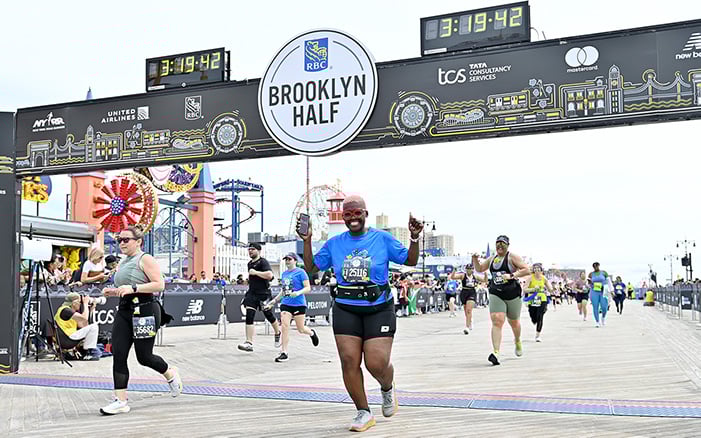
What’s considered “slow” in a half marathon
“Slow” in running terms usually means finishing near or beyond the back of the pack—but that still covers a wide range. Most large U.S. half marathon races list average finish times around 1:50–2:30 (8:30–11:30 per mile or 5:17–7:09 per km).
The average woman finishes around 2:27, the average man around 2:05, according to Running USA report. The back of the field often crosses the line between 3:00 and 3:45—and every one of them earns the same medal.
Anything over three hours is generally seen as a slower or walking pace, though it’s still well within official race limits.
A 3-hour finish equals roughly 13:44 per mile (8:32 per km), while 3:30 works out to 16:00 per mile (9:57 per km). At those speeds, many runners combine jogging and walking, maintaining steady effort instead of constant running.
So, you can “run” a half marathon at a 15–16-minute mile pace and still be considered a runner—not a walker—if your main intention is to run portions of it and finish within cutoff time.
Minimum pace and cutoff times
Every race has a practical limit, usually set between 3 and 4 hours. That means you need to maintain roughly a 13:44–18:18 per mile pace (8:32–11:22 per km) to stay ahead of course closures and sweep vehicles.
Cutoffs are not meant to exclude slower runners; they exist for practical reasons. City roads can only stay closed for so long, volunteers have shifts, and medical teams can’t remain on duty indefinitely.
Some races are more flexible. Events like the Rock ’n’ Roll Series or Disney races openly welcome walkers, provided they start early and keep a steady forward pace. Others, like the NYC Half, have firm cutoff times but allow participants to continue on sidewalks if needed.
If you’re uncertain, check the event website. A posted “pace requirement” often means the time starts when the last wave crosses the start line—not when the gun goes off—giving you extra minutes of buffer.
How to train for a slower half marathon
The approach for a 3-hour half doesn’t differ much from a 2-hour one—it just emphasizes endurance over speed. Your goal isn’t to hit specific splits but to spend enough time on your feet to handle the distance comfortably.
The Jeff Galloway walk-run method works well for slower half-marathon training. Alternate short running intervals with brief walks, adjusting the ratio as your stamina improves. This strategy keeps effort manageable and helps you avoid late-race fatigue.
Focus on building one long run each week, increasing its duration gradually. During long runs, practice maintaining the pace you’ll need on race day—around 14–15 minutes per mile (8:40–9:20 per km)—to see how it feels over time. This range roughly matches the pace required to finish within a 3–3.5-hour cutoff, giving you a realistic sense of your effort level and endurance.
Cross-train with cycling or brisk walking to strengthen your aerobic base. And don’t neglect the details: chafing protection, hydration, and fueling all become more important when you’re on the course for three or more hours.
For example, practice taking in fluids every 20–30 minutes and consuming energy gels or chews around the 45–60-minute mark. Longer time on course means more sweat loss and more energy demand, even at an easier pace.
The mindset of finishing, not racing
Training for a slower half marathon is as much a mental project as a physical one. You’ll be out there longer, often with thinner crowds and fewer spectators. But that solitude can work in your favor—it’s time to focus on rhythm, breathing, and steady effort.
Don’t measure your success by someone else’s stopwatch. Running 13.1 miles is the same accomplishment whether it takes you 90 minutes or four hours. Every finisher earns the same medal and covers the same ground.
Related: Marathon Mindset: The Mental Skills Every Runner Needs
Conclusion
There’s no “too slow” half marathon pace—only race policies and personal goals.
Most events give you at least three hours, sometimes more, to complete the course. What matters most isn’t how quickly you finish, but that you prepare and participate.
The clock doesn’t define your run. Effort, persistence, and the satisfaction of finishing 13.1 miles do.


