

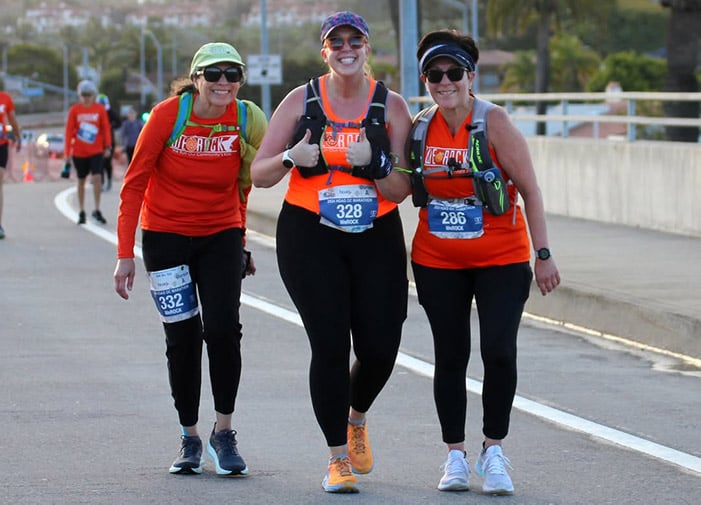
You don’t have to run to join the race. Plenty of people set out to walk 13.1 or 26.2 miles—on purpose. And whether you're recovering from injury or training for your first endurance event, walking a half or full marathon is absolutely doable.
But how long does it take? What kind of pace do you need? And is walking even allowed in most races? Let’s break it down.
Can you walk a half or full marathon in a race?
Yes—and in many races, you won’t be alone.
Most half-marathons openly welcome walkers, and many full marathons do too. The key detail to check is the cutoff time, which is how long the course stays open.
For half marathons, that’s usually 3 to 4 hours, meaning you need to maintain roughly a 17–18-minute-per-mile pace (10:30–11:10 min/km) or faster.
For full marathons, the cutoff is often 6.5 to 7 hours, requiring a pace of about 18 minutes per mile (11:10 min/km) or quicker to be counted as an official finisher.
Some well-known races support walkers under certain pacing limits (e.g., Disney). Others may reopen roads or close refreshment stations earlier, so knowing the rules ahead of time matters.
Walking in an official race means you're fully supported—with aid stations, cheering crowds, medical staff, and volunteers along the course, plus a medal waiting at the finish.
Why some people choose walking over running
Choosing to walk is often a deliberate and thoughtful decision.
Some people are working through injuries or chronic joint pain. Others simply don’t enjoy running but still want to challenge themselves with long distances.
Walking can also be a more social experience, a mental reset, or a manageable entry point into endurance sports.
And for many, consistency matters more than intensity. Training for a walking marathon or half still requires dedication, time, and physical effort—you’re just moving at your own pace toward the same finish line.
What’s a typical walking pace?
The average walking pace for adults falls between 15 and 20 minutes per mile (9:20 to 12:30 per kilometer). That’s a brisk walk, not a stroll.
If you're moving closer to 15 minutes per mile (9:20 min/km), you're on the faster side of recreational walking. Slower walkers might hover around 18 to 20 minutes per mile (11:10–12:30 min/km), especially on hilly courses or in warmer weather.
Your final time depends on how well you maintain that pace over distance and how long your breaks are. Training with a GPS watch or pace app can help you find your sustainable rhythm.
Estimated finish times at different paces
Here’s how long a half or full marathon might take at common walking speeds:
- 15:00 min/mile (9:20 min/km) Half-marathon: ~3 hours 17 minutes Marathon: ~6 hours 33 minutes
- 16:00 min/mile (9:56 min/km) Half: ~3:30 Full: ~7:00
- 17:00 min/mile (10:34 min/km) Half: ~3:43 Full: ~7:25
- 18:00 min/mile (11:10 min/km) Half: ~3:56 Full: ~7:52
- 20:00 min/mile (12:26 min/km) Half: ~4:22 Full: ~8:44
If you're aiming to finish within a race’s official time limit, aim for 17–18 min/mile (10:34–11:10 min/km) or faster. And remember—your pace may drop slightly in the second half, so build that into your plan.
Tips for walking long distances
To cover 13.1 or 26.2 miles comfortably, you’ll need a consistent training plan and the right gear. Here’s what matters:
- Train for time, not just miles. Walking a marathon means being on your feet for 6 to 9 hours. Your body needs to get used to that. Gradually increase the duration of your long walks each weekend, and practice walking at your target pace.
- Practice fueling and hydration. Just because you’re not running doesn’t mean you can skip nutrition. If your walk lasts more than 90 minutes, bring water and snacks. On marathon day, you’ll need a plan for electrolytes and carbs—just like a runner.
- Invest in good shoes and socks. Look for well-cushioned walking or running shoes with a roomy toe box and plenty of arch support. Technical socks (synthetic blends) help prevent blisters during long hours of movement.
- Watch your form. Keep your shoulders relaxed, arms bent at 90 degrees, and eyes forward. Shorten your stride and focus on a quick, efficient cadence to avoid overuse injuries.
- Test race-day gear in advance. Don’t wear anything for the first time on race day. Practice in the same clothes, shoes, socks, and hydration system you plan to use.
Related: 20 Reasons Why Slow Runners Should Participate in a Race
Walking a half or full marathon isn’t the “easy” version of a race. It still requires training, pacing, and mental grit over the long haul. If you're walking in an official event, check the cutoff times in advance and aim to stay close to a 16–18 minute per mile pace (9:56–11:10 min/km) to stay within the time limit.
Whether you run or walk, 13.1 or 26.2 miles is a real test of endurance—and every mile walked counts just as much.


