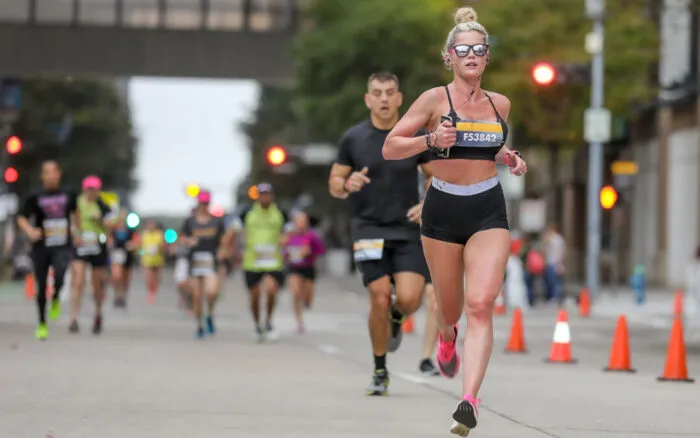
Not all marathons are created equal. When the goal is a personal best, race choice matters as much as training.
For runners chasing speed this season, we’ve put together a list of 10 U.S. marathons known for flat courses, reliable weather, and fast results.
1. Chicago Marathon
Where: Chicago, Illinois
When: October 11, 2026
Website: chicagomarathon.com
Course profile: The city course is completely flat: the elevation changes are minimal and the total gain is about 243 feet, or roughly 74 meters, over the entire distance.
The route winds through Chicago’s streets with no meaningful climbs, which is exactly why it’s consistently ranked among the fastest marathons in the world.
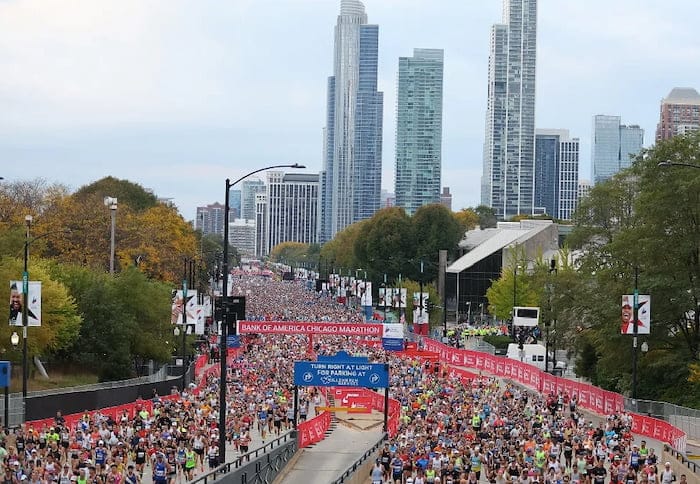
A pancake-flat course combined with typically cool October temperatures creates near-ideal conditions for running fast.
Chicago is part of the World Marathon Majors series, and countless personal bests—and world-class performances—have been set here. Many runners choose it for their first marathon or a PR attempt thanks to the forgiving terrain and exceptionally smooth race-day organization.
The main challenge is the scale of the event. With tens of thousands of runners on the start line, early miles can feel crowded, especially if you’re not seeded accurately. To avoid unnecessary congestion, start in the correct corral based on your pace.
Entry itself can also be a hurdle. Most runners enter through the annual lottery, which opens in the fall, while others qualify with a time standard, run for an official charity, or secure entry via an international tour operator.
If you can get in and manage the crowds, Chicago remains one of the most reliable PR courses in the US and a classic choice for those aiming for the best result.
2. Mesa Marathon
Where: Mesa, a suburb of Phoenix, Arizona
When: February 14, 2026
Website: mesamarathon.com
Course profile: Fast course with a downward slope. The Mesa Marathon, formerly known as the Phoenix Marathon, starts outside the city on the slopes of Usery Mountain and finishes in the city of Mesa.
The total elevation change is about 1,154 feet (351 meters): the start is on a high plateau at around 2,086 feet (636 meters) above sea level and descends to the finish at about 932 feet (284 meters).
The first few miles are on a desert highway with a gradual descent, including one noticeable climb at miles 5–6 (8–10 km). After that, the course goes down again, and the last 6.2 miles (~10 km) descend almost entirely to the valley floor. The total elevation gain is about 288 feet (88 meters), and the total descent is around 1,154 feet (351 meters).
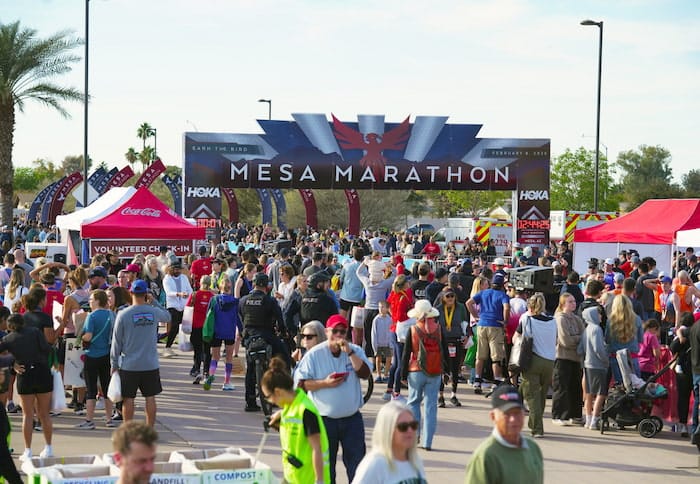
The Arizona winter sun provides pleasant morning temperatures, typically around 41–46°F (5–8°C), with no snow or ice. The dry desert climate means rain and humidity are rarely an issue.
The biggest advantage of the Mesa Marathon is its long, gradual descent that helps runners maintain a faster pace without putting too much strain on the knees.
Toward the finish, when energy is fading, the course flattens out, the final miles run through city streets with almost no incline, making it easier to hold your pace.
No wonder this February race is a favorite among Boston Qualifier (BQ) and personal record seekers. Many runners say Mesa is one of the best ways to kick off the season with a strong time.
The organizers understand why runners choose this course. Every Boston qualifier receives a special “BQ” luggage keychain at the finish—a small but satisfying reminder that, as the organizers like to say, the road to Boston runs through the Valley of the Sun. (Phoenix’s nickname).
3. Ventura Marathon
Where: Ventura, California
When: February 22, 2026
Website: venturamarathon.com
Course profile: The point-to-point course starts in the foothills outside Ojai and finishes near the Pacific Ocean in Ventura, delivering a steady net downhill of about 700 feet (213 meters).
Total elevation gain is minimal, about 450 feet (137 meters) in small rolling sections, but the overall profile goes steadily downhill.
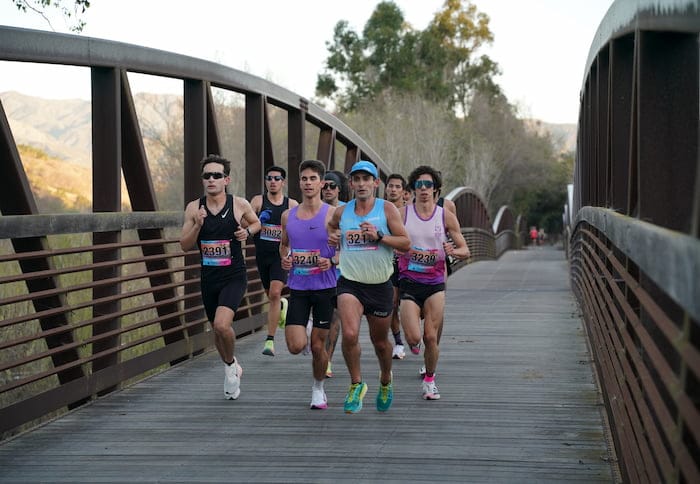
The Ventura Marathon is one of California’s PR gems. Much of the race follows the Ojai Valley Trail, a wide paved path with long straight sections and very few sharp turns.
The setting is calm and scenic. Add to that the cool, coastal air and you’ve got prime conditions for a personal best or a Boston Qualifier.
If you like downhill speed, predictable weather, and a low-stress race environment, Ventura is an easy one to recommend.
4. Baystate Marathon
Where: Lowell, Massachusetts
When: October 18, 2026
Website: baystatemarathon.com
Course profile: A two-loop route around the town of Lowell, running mostly along the Merrimack River. The course is almost entirely flat, with minimal elevation gain, about 507 feet (154 meters) total, mainly due to a few bridge crossings.
Each loop includes a couple of short climbs to the bridges, immediately followed by a descent, so they don’t significantly impact your average pace. The rest of the route is made up of long, flat stretches along the riverbanks and city streets.
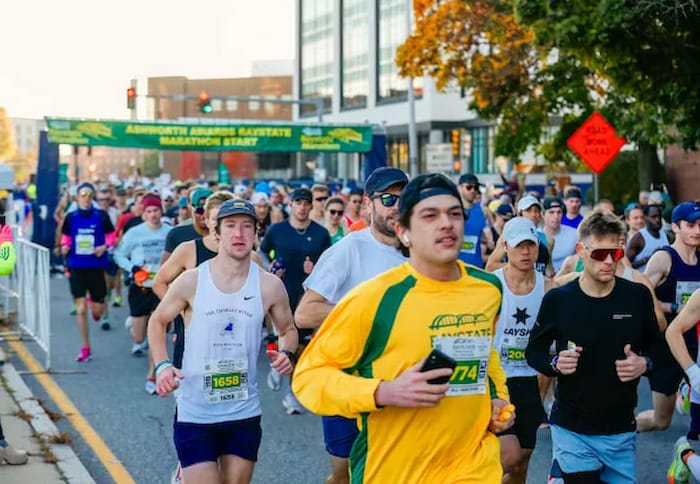
The Baystate Marathon was designed from the start as a race to qualify for Boston, and it delivers. In the past two years, about 28% of marathon finishers have hit their BQ time here, which makes it one of the top races in the country for that purpose.
Mid-October is usually ideal for running: cool, dry air (around 50°F / 10°C) and classic fall colors.
The two-loop format helps with pacing, the first loop lets you get familiar with the course, and the second one gives you a clear idea of where you can push. The course is USATF-certified, well measured, and trusted by runners who want a clean result.
What really sets Baystate apart is the race atmosphere. There are no massive crowds, no distractions, and no early congestion. You line up with runners who are there to run fast, not to sightsee.
5. Wineglass Marathon
Where: Corning, New York
When: October 4, 2026
Website: wineglassmarathon.com
Course profile: A fast point-to-point route through the scenic Finger Lakes wine country.
The race starts in Bath, NY at around 1,158 feet (353 meters) above sea level and finishes in Corning at about 928 feet (282 meters). That’s a net descent of roughly 230 feet (70 meters), but overall, the course feels flat.
Total elevation gain is about 411 feet (125 meters).
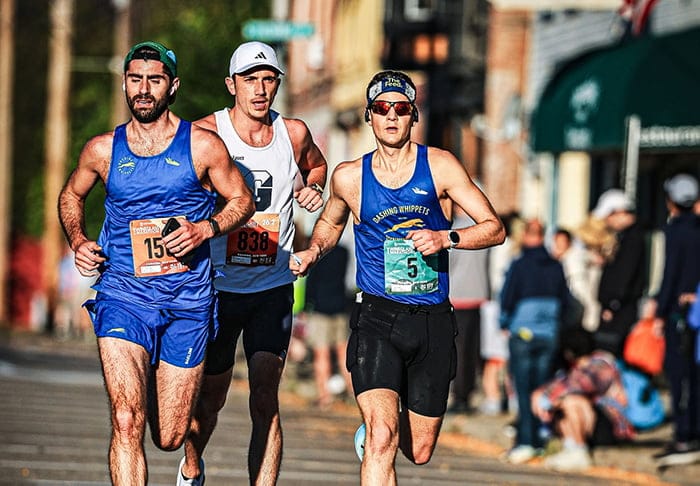
Wineglass consistently ranks among the top U.S. marathons for Boston qualifiers. With its gentle descent and no major climbs, the course lets you keep a steady rhythm the whole way.
The early October weather in upstate New York is usually runner-friendly: cool mornings (around 40°F / 5°C) and mild afternoons (~59°F / 15°C).
Runners love the calm, local feel of this race, it’s small enough to feel personal, but the course itself is every bit as fast and well-organized as the majors.
6. Indianapolis Monumental Marathon
Where: Indianapolis, Indiana
When: November 7, 2026
Website: monumentalmarathon.com
Course profile: One of the flattest marathons in the U.S. As runners like to say, “It’s hard to imagine a flatter course than the Indy Monumental.”
The route forms a large loop through the streets and neighborhoods of Indianapolis. The total elevation gain is no more than about 302 feet (92 meters), the terrain is nearly imperceptible.
The only noticeable bump comes around mile 16 (~26 km), and even that is short and manageable. Everything else is either pancake-flat or has a barely noticeable grade.
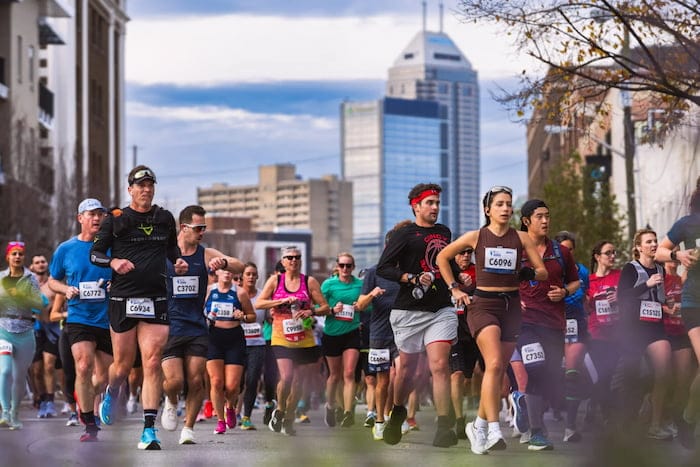
Late fall in Indiana usually offers perfect running conditions: crisp, cool air around 41°F (5°C), with little wind or rain.
On a course this flat, that kind of weather sets you up to go all-out. The race is well-organized and attracts a strong field of runners aiming for Boston. Many praise the smooth logistics and fast, USATF-certified route that makes it ideal for a BQ attempt.
7. Philadelphia Marathon
Where: Philadelphia, Pennsylvania
When: November 22, 2026
Website: philadelphiamarathon.com
Course profile: A big-city marathon course that’s generally considered flat. The first 12 miles (~20 km) are smooth and level, running through downtown streets and historic areas. After that, there are some rolling sections, small hills in Fairmount Park and near the Schuylkill River.
Total elevation gain is around 744 feet (226 meters), which is moderate, with no steep or long climbs. Much of the course runs on wide, paved roads along the riverfront and through city parks.
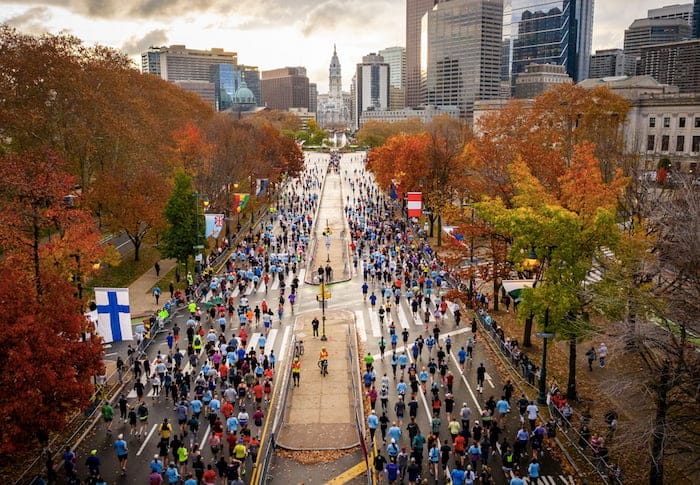
The Philadelphia Marathon is a great blend of big-city energy and fast racing. It’s often called a more relaxed alternative to Boston or New York: wide streets, fewer crowds, and a smoother pacing experience.
The weather in mid-November is usually ideal for racing: around 41–50°F (5–10°C), cool and crisp without much wind. That’s one reason why so many runners clock strong times here.
The route is USATF-certified and offers a good mix of flat sections and iconic views, from the Liberty Bell to the steps of the Art Museum. These help keep you mentally engaged, especially through the first half.
If you’re comfortable with light rolling terrain and want a fast race that still feels like a major city marathon, Philadelphia is a reliable option.
8. Houston Marathon
Where: Houston, Texas
Where: January 17, 2027
Website: chevronhoustonmarathon.com
Course profile: Flat urban course with minor elevation changes. The course runs along the streets of Houston and includes only a few gentle bridges and overpasses, which have little effect on the pace.
The total elevation gain is about 225 feet (approximately 68 meters) — the course is mostly flat.
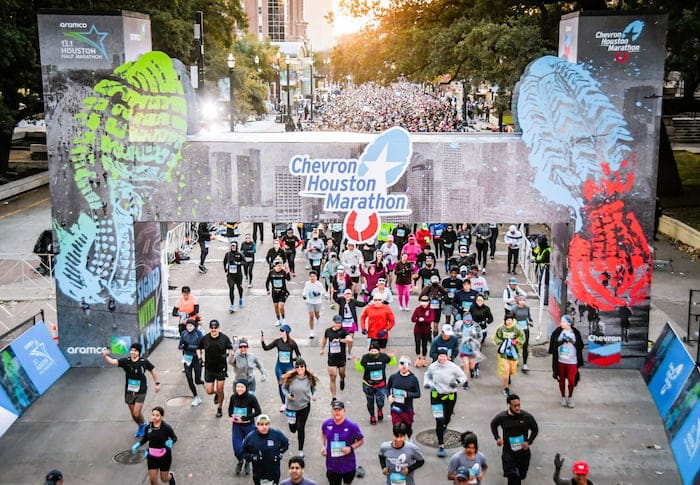
The winter climate in Texas is usually mild: the temperature at the start is often around 41–50°F (5–10°C), which is ideal for a marathon.
The Houston Marathon is famous for its excellent organization and fast participants. Runners appreciate the smooth operation of the starting corrals, plentiful aid stations, and fun support spots along the route. Competition among strong runners is high here, which also contributes to faster times.
Despite the cool season, Houston can sometimes feel humid even in winter. Experienced participants recommend taking the weather into account and starting a little bit slower to avoid overheating.
Otherwise, it’s a fast and reliable race, with many runners qualifying for Boston every year.
9. St. George Marathon
Where: St. George, Utah
When: October 3, 2026
Website: stgeorgemarathon.com
Course profile: A point-to-point mountain marathon with a major net downhill.
The race starts in the Pine Valley Mountains at about 5,244 feet (1,598 meters) above sea level and finishes in downtown St. George at approximately 2,685 feet (818 meters). That’s a net drop of around 2,559 feet (780 meters).
The course trends downhill nearly the entire way, making it one of the fastest fall marathons in the U.S. You’ll encounter a couple of climbs along the way, especially near the town of Veyo, where the route gains about 492 feet (150 meters).
Still, with good pavement, wide-open roads, and views of Utah’s red rock canyons, the terrain plays in your favor.
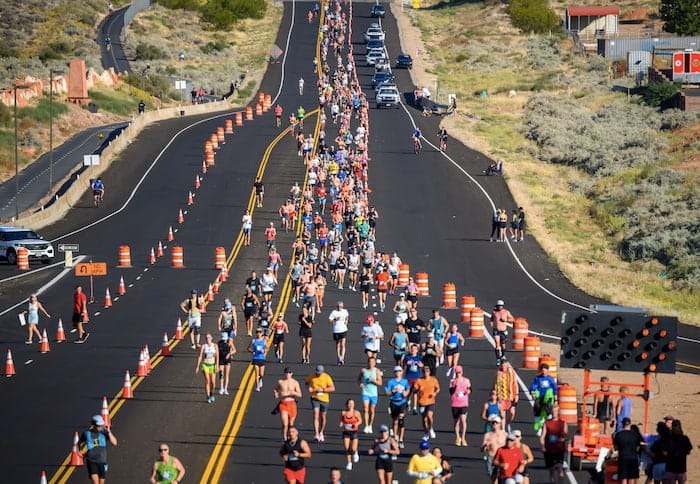
The massive elevation drop allows you to run faster with less effort, if your quads are trained for it.
Temperatures at the mountain start are usually cool, around 41°F (5°C) at sunrise, and gradually warm to a comfortable 59–64°F (15–18°C) by the finish in town.
Seasoned St. George runners recommend training specifically for long downhill stretches to handle the eccentric load on your legs. If you show up prepared, this course becomes a powerful ally on your way to a breakthrough race.
Because of its net drop, St. George is popular with runners chasing big time goals, and registration fills quickly.
10. Grandma’s Marathon
Where: Duluth, Minnesota
When: June 20, 2026
Website: grandmasmarathon.com
Course profile: A point-to-point course that starts in Two Harbors and follows the scenic North Shore of Lake Superior, finishing in Duluth’s Canal Park.
The route has a gentle net downhill, the starting elevation is around 737 feet (224 meters), and the finish is about 605 feet (184 meters), for a total drop of roughly 132 feet (40 meters).
Total elevation gain is approximately 557 feet (170 meters), and the descent totals about 685 feet (208 meters). The road is paved the entire way and mostly flat, with a few very mild rolling hills, the only notable one being Lemon Drop Hill around mile 22.
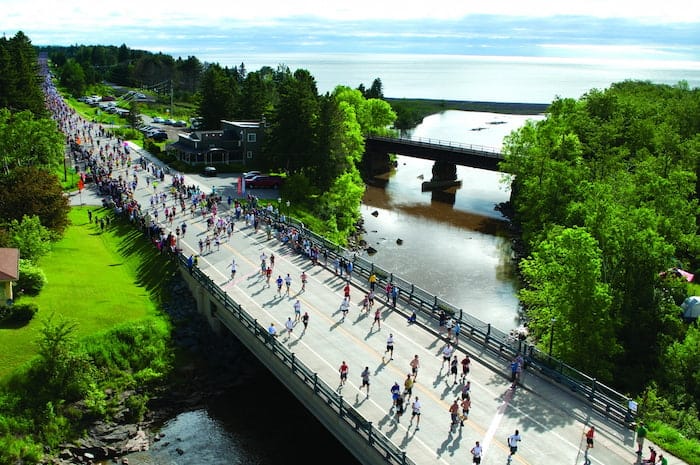
Grandma’s Marathon has a reputation for being both beautiful and fast.
June weather in northern Minnesota is typically perfect for racing, cool mornings around 50–55°F (10–13°C), low humidity, and light breeze off the lake. The long, straight road and gentle descent allow for smooth pacing and strong finishes.
In 2024, 1,393 runners qualified for Boston at Grandma’s, that’s about 18% of all finishers, one of the highest BQ percentages among U.S. marathons. The course is USATF-certified and well-organized, with strong crowd support in the later miles and a high-energy finish near the water.
Related: 25 Most Epic Marathons to Run This Year
If you want to run fast and set a new PR, training is only part of the equation. Choosing the right course matters just as much. These 10 marathons are time-tested options where the terrain doesn’t get in the way—it helps.
Pick the race that fits your season and your goals—whether that’s a new personal best or finally qualifying for Boston.