You signed up for a half marathon—maybe for a New Year’s goal, a charity, a friend’s challenge, or just to prove you could. Weeks passed, life got busy, and training never happened. Now race day is coming, and you’re wondering: can you actually finish 13.1 miles (21.1 km) without preparation—and what happens if you try?
Below, we’ll look at what your body goes through when you run untrained, what a realistic finish time looks like for a beginner, how to survive a race, and how long it really takes to train for a half marathon properly.
What happens if you run a half marathon untrained
“Untrained” here means no steady weekly mileage and no gradual long-run buildup.
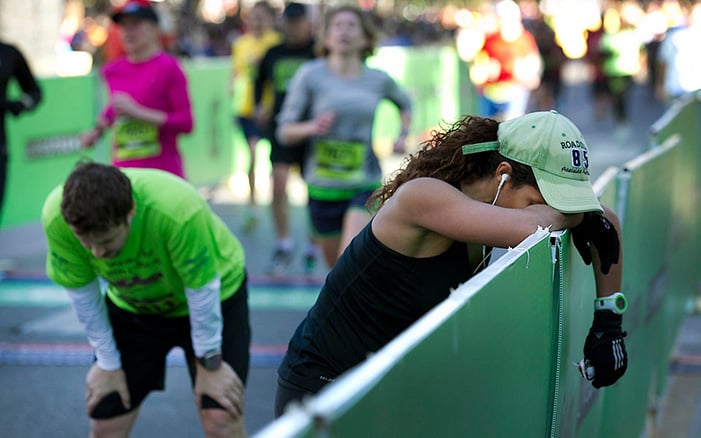
Early miles often feel deceptively fine; the novelty and fresh legs carry you. By mile 6–7 (9.5–11 km), form starts to wobble as hips and calves fatigue. Around miles 8–10 (13–16 km), the combination of impact, dwindling glycogen, and rising effort turns every small incline into a problem.
Common outcomes:
- hot spots that become blisters mid-race
- calf or hamstring cramps after long stretches without walk breaks
- IT band or knee pain once stride shortens and cadence drops
- a long recovery window (delayed onset muscle soreness peaking 24–48 hours, lingering soreness 3–7 days)
Yes, you might cross the line. Expect to pay for it with deep soreness and a recovery that lasts days, maybe weeks, before you even think about training again.
Related: 10 Tips for Running a Half Marathon Without Stopping
Who might actually manage to finish strong
People with real aerobic history—cyclists, hikers, rowers—can sometimes muscle through. They’re used to long sessions and steady fueling.
Still, running’s impact is different. Even fit athletes might end up walk-running after the halfway mark.
- one
- two
- free
What a realistic finish time is
If you try it anyway as a complete beginner, a realistic finish window is 3:00–3:30 hours—that’s roughly 13:45–16:00 per mile (8:30–9:55 per km). It’s a steady walk-run pace that still keeps you within most race cutoffs but feels hard from mile eight onward.
How to survive a race if you signed up but didn’t train
If the race is around the corner and training never happened, don’t panic. Here’s how to get through your first half marathon with minimal suffering.
Start farther back to avoid going out too fast. Keep it slow from the start. The mistake most people make is waiting until they’re exhausted to walk. Mix short walk breaks in early—every mile, every water stop, whatever keeps your breathing steady. Keep it “conversation-easy.” If you can’t speak in phrases, back off.
Eat before you’re hungry, drink before you’re thirsty. Take something small at mile 4 or 5 (6–8 km), then again every half hour. A sip at each station is enough. Don’t skip electrolyte drinks if the weather is warm.
Don’t wear anything new. Dry running socks, tested shoes and gear, body glide where it matters.
By mile 8 (13 km), the fun part is over. From there, it’s rhythm and stubbornness. Stay light on your feet, keep your chest up, shake out your hands when they tighten—scan posture every mile.
Non-negotiable stop signs:
- spinning head
- chest tightness
- sudden sharp pain
- goosebumps or chills in warm weather
- confusion
- vision changes
If any of these show up, slow to a walk immediately, move to the side of the course, and flag a volunteer or medical staff. Sit only if you feel faint, and keep sipping small amounts of fluid while you wait for help.
Related: How Slow Can You Run a Half Marathon—and Still Call It a Run?
What to do after the race
The next 72 hours determine how quickly you feel normal again.
- Hour 0–2: carbs + protein (3:1 ratio), 17–25 oz (500–750 ml) fluids with electrolytes, gentle walking.
- Day 1: 20–30 minutes easy spin or walk; light mobility; sleep 8+ hours.
- Day 2: short walk again; if soreness is sharp or one-sided, skip running.
- Day 3–4: test an easy 20–25-minute jog only if you’re pain-free on stairs.
If pain persists past a week—or you notice swelling that doesn’t settle—book a professional assessment.
Is running it untrained “worth it”?
If you have to ask, you probably care about more than a finisher photo. Yes, you can shuffle through a half marathon on grit, but the trade-off is steep, and for most people, it’s not worth the strain.
The experience improves dramatically with even eight focused weeks. Training makes the difference between guarding a cramp and cruising the last mile.
How long it really takes to train for a half marathon
If this race ends with sore quads and a promise to do better, good. A proper build changes everything: steadier pacing, faster recovery, less pain, more joy.
Here’s how much time you need to prepare for a half marathon:
- True couch-to-half beginners: 14–16 weeks
- Some running base (can jog 5K comfortably): 10–12 weeks
- Decent base (3–4 runs/week; long run ~6–7 miles / 10–11 km): 8–10 weeks
Those weeks buy you tendon, bone, and joint adaptation, not just cardio. That’s why finish lines feel different after following a plan.
What to include in your training plan
Keep it simple and repeatable.
Weekly structure (3–4 runs):
- 2 easy runs: 30–50 minutes, relaxed.
- 1 long run: build from 4–5 miles to 10–12 miles (6–16 km), adding no more than 1–1.5 miles most weeks.
- 1 optional quality workout: short hill reps (6–8 × 30–45 seconds) or gentle tempo (15–20 minutes “comfortably hard”) once you’re at 15–20 miles/week total.
Round it out with:
- Cross-training (1–2×/week): cycling, swimming, or elliptical 30–45 minutes; plus 2×/week short strength blocks (single-leg RDLs, step-downs, calf raises, side planks).
- Rest and cutbacks: every 3–4 weeks, trim long-run distance by 20–30% for a recovery week.
- Fueling practice: on long runs >60–75 minutes, take 30–45 g carbs/hour via gels or chews; sip fluids every 15–20 minutes. Test your breakfast timing (2–3 hours pre-run) and stick with what sits well.
Conclusion
Running a half marathon without training is possible, but rarely pleasant. Most untrained runners cross the line somewhere around 3:00–3:30 hours, often in pain and needing a week or more to recover. The body can survive 13.1 miles once—but it won’t enjoy it.
If you’re already committed, take it easy: start slow, walk-run the distance, fuel often, and listen when your body says stop.
If you’re planning ahead, aim for a 10–14 week training window depending on your current fitness. Build gradually and focus on consistency instead of pace. That’s how you finish stronger, recover faster, and actually want to do it again.